






Directed Energy: The Future of Defense Is Built in Optics Valley
If you want to know what the future of defense looks like, stop thinking about missiles, bullets, or giant rocket launchers. The next wave is quieter, cleaner, faster, and powered by something Tucson knows better than almost anywhere else on the planet: light.
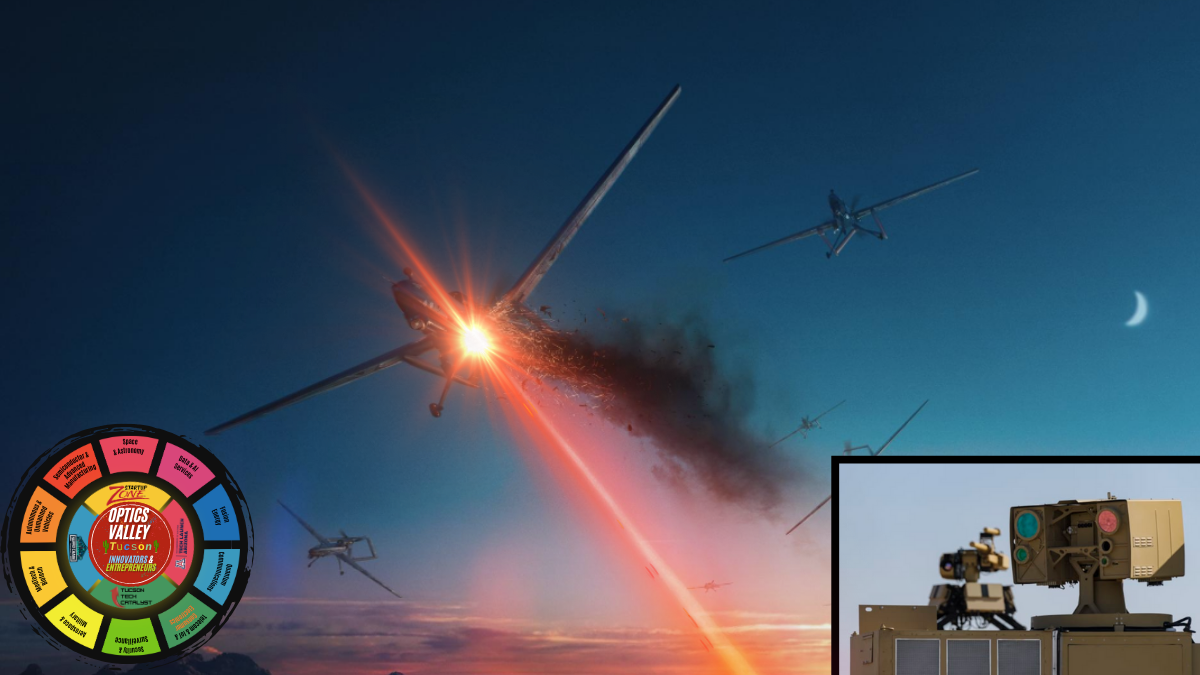
Welcome to the world of directed energy (DE), a field where lasers, high-power microwaves, and advanced optics replace explosives. It sounds like science fiction, but in Optics Valley, it’s already happening in labs, startups, and test ranges across Arizona.
Directed energy applications, which are part of the $1 trillion global optics-photonics-enabled industries. The growth is driven by transformative applications in AI, healthcare technology, quantum computing, directed energy, and clean energy. We should elevate our planning and execution to include this catalyst for innovation and growth.
What Directed Energy Actually Is
Directed energy (DE) is simply energy aimed at a target in a focused beam. Instead of firing a physical object, DE systems shoot concentrated light or electromagnetic energy. There are three main types:
- High-Energy Lasers (HELs) – beams of light that heat and burn targets
- High-Power Microwaves (HPMs) – electromagnetic waves that fry electronics
- Particle Beams – experimental systems that accelerate charged particles
Think: “the power of the sun in a laser cannon the size of a Jeep.”
These systems can destroy or disable drones, knock out sensors, stop vehicles, blind optics, and potentially defend against hypersonic missiles in the future. And they do it with incredible precision and extremely low cost per shot, sometimes just a few dollars in electricity.
This is why every major defense prime contractor is investing heavily in DE. And it’s why Optics Valley is quietly becoming one of the top places in the world to build it.
Why Tucson Is Perfect for Directed Energy
Directed energy requires five core ingredients:
- Precision optics
- High-power lasers
- Beam control and tracking
- Thermal engineering
- Harsh-environment testing
Tucson checks all five core ingredients.
University of Arizona – Wyant College of Optical Sciences: The Quiet Powerhouse
If lasers are the engines of directed energy, optics are the steering, fuel delivery, and targeting systems.
Tucson also boasts the best optics school in America.
The Wyant College of Optical Sciences produces:
- world-class lens designers
- laser engineers
- mirror specialists
- beam-control researchers
- photonics innovators
If DE needs it, Wyant trains it.
Optics Valley Supply Chain: The Hidden Machine Shop of Light
You can’t build a directed-energy weapon without:
- adaptive mirrors
- optical coatings
- precision mounts
- custom glass
- beam directors
- detectors
- high-energy laser modules
- ruggedized enclosures
- tracking systems
- thermal sinks
Guess what hundreds of Southern Arizona companies already make?
Exactly those things.
Many don’t call themselves “directed energy companies,” but they produce the components that DE systems cannot function without. This is a massive opportunity for founders.
Test Ranges: Arizona Is a Directed Energy Playground
Directed energy must be tested outdoors in real conditions: heat, dust, long distances, and clear skies.
Arizona has all of that, plus military ranges that already host DE evaluations. Including…
- drone shoot-downs
- optical tracking tests
- thermal stress tests
- long-range laser propagation
Tucson isn’t just a hub for tech. It’s a proving ground.
Where Startups Can Win (Right Now)
Directed energy isn’t only for billion-dollar defense primes. There are cracks in the armor where hungry founders can build scalable companies. Here are the biggest openings:
Thermal Management Innovations
High-energy lasers turn into high-energy heat. Cooling systems are the bottleneck.
Startups can build:
- advanced heat sinks
- phase-change cooling materials
- smart thermal controllers
- AI-optimized cooling loops
Drone Defense Software & AI Targeting
DE systems rely on:
- object recognition
- tracking algorithms
- AI-predicted flight paths
- multi-sensor fusion
Optics Valley startups can develop AI brains for DE hardware.
Beam Directors, Coatings & Rugged Optics
Lasers need mirrors and coatings that can survive brutal power levels. If your company can make:
- high-damage-threshold coatings
- adaptive optics
- fast-steering mirrors
…you’re golden.
Compact Laser Modules & Power Systems
There is a massive demand for small, rugged, power-efficient laser sources.
Startup opportunities include:
- diode-pumped solid-state lasers
- fiber-laser modules
- laser-power conditioning units
Field Diagnostics & Calibration Tools
DE systems need constant alignment and recalibration.
Startups can create:
- portable interferometers
- alignment trackers
- laser-health diagnostics
- sensor-calibration automation
Think “Snap-On Tools,” but for high-energy lasers.
Training, Simulation & Safety Systems
No one wants to blind a satellite or set a mountain on fire.
DE needs:
- virtual training systems
- safety simulation models
- range-control software
Another huge startup gap.
Optics Valley’s Moment
America is racing to develop the next generation of defense systems, and directed energy is at the forefront of that effort. The question is not if DE becomes mainstream… but how fast.
Tucson has:
- the research muscle
- the photonics supply chain
- the skilled engineers
- the culture of experimentation
This is a once-in-a-generation chance for founders, builders, and innovators to own a piece of the future.
Directed energy isn’t science fiction.
It’s Optics Valley’s next trillion-dollar industry.
And the question for Tucson startups is simple:
Will we build it here or watch someone else do it?