






How to Build a Successful Startup
Or do You Prefer to Build Blindly
Most startups don’t fail because the founders aren’t smart. The hard truth is that they fail because they build something nobody wants.
Too many founders jump straight into building. They fall in love with their idea, write code, design features, and spend months in isolation. Then they launch… and hear silence. No traction. No customers. No momentum.
There’s a better way to build.
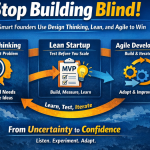
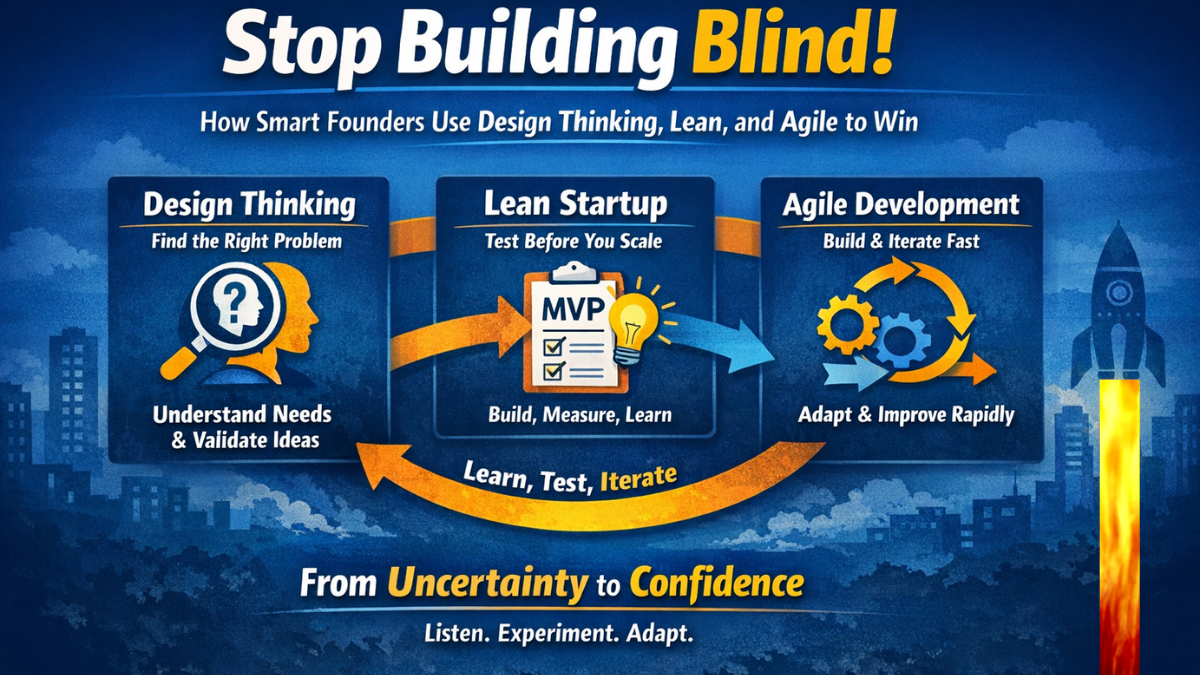
Smart founders don’t just build faster. They learn faster. And they do it by combining three powerful methods: Design Thinking, Lean Startup, and Agile.
Together, these create a simple but powerful system that moves you from high uncertainty to high confidence.
Start Here: Design Thinking (Find the Right Problem for the Right Archetype)
Before you build anything, you need to answer one question:
What problem actually matters to my archetype (target customer persona)?
This is where Design Thinking comes in. It forces you to slow down and understand your customer. You talk to them. You listen. You observe. You look for frustration, hair-on-fire problems, pain, and unmet needs.
This is not about your idea. It’s about their reality and then how your idea may be applied.
Most founders skip this step. They assume they already know the problem. That’s where things break.
Design Thinking helps you focus on desirability to solve big problems. In simple terms:
Do people care enough about this problem?
If the answer is no, nothing else matters. Then find another archetype and its associated hair-on-fire problem.
Next: Lean Startup (Test Before You Build and Grow)
Once you believe you’ve found a real problem, it’s time to test your idea.
This is where Lean Startup comes in.
Instead of saying, “This will work,” you say, “This is a hypothesis.” Then you test it.
You build a Minimum Viable Product (MVP). Not a product but a wireframe. Then not a perfect product. Just enough to learn.
Then you put it in front of real people.
Do they use it? Ignore it? Do they give you some currency? Are they willing to provide a Memorandum of Understanding (MOU) and commit to using it when it’s ready?
This stage is about viability.
Is there a real market for this?
Here’s the key:
You are not trying to prove yourself right.
You are trying to find the truth.
Every assumption is a risk. Validate or invalidate it.
Then: Agile (Build What Works)
Once you have real evidence that your solution is in demand, you can build.
This is where Agile comes in.
Agile is not about speed alone. It’s about controlled, smart execution.
You build in short cycles called sprints. You release small improvements. You get feedback. You adjust. Then you repeat.
Instead of betting everything on one big launch, you improve step by step.
This stage focuses on feasibility.
How do we build this effectively and then scale it?
Agile keeps you flexible. It prevents you from locking into bad decisions too early.
The Real Power: The Loop
Here’s what most people miss:
This is not a straight line.
It’s a loop.
You don’t go from Design Thinking → Lean → Agile and stop.
You move forward, learn something, and often go back.
- Agile feedback may send you back to Lean
- Lean results may send you back to Design Thinking
- Customer behavior keeps shaping everything
This is how efficient and effective startups are built.
Not in isolation. Not in a straight plan. But through continuous learning and testing every assumption.
Final Thought
This isn’t just a framework.
It’s a mindset.
The best founders don’t win because they have the best ideas.
They win because they reduce risk faster than everyone else. This attracts institutional investors faster than most factors.
Stop building blind.
Start learning.
Start ideating and iterating.
Pivot if you must.