





Being Busy is Not the Same as Successfully Launching Startups
Being busy is not the same as building my startup, and I really want to start there because I learned that the hard way. For a long time, I thought that if my calendar was full, my inbox was overflowing, and I was constantly switching between tasks, then I must be doing something important. It felt productive. It felt like progress. But the truth is, I was just busy. I wasn’t building anything meaningful. And there’s a big difference between the two that most of us don’t realize until we step back and look at what we’ve created.
When I say “busy,” I mean doing a lot of things that feel urgent but don’t really move the business forward in a lasting way. It’s answering random messages all day, tweaking small details that don’t matter yet, jumping into meetings that don’t lead to decisions, and constantly reacting instead of planning. It gives you the illusion of progress because you’re always doing something. But building a company is different. Building means creating systems, making decisions that can scale, and focusing on what still matters a year from now, not just today.
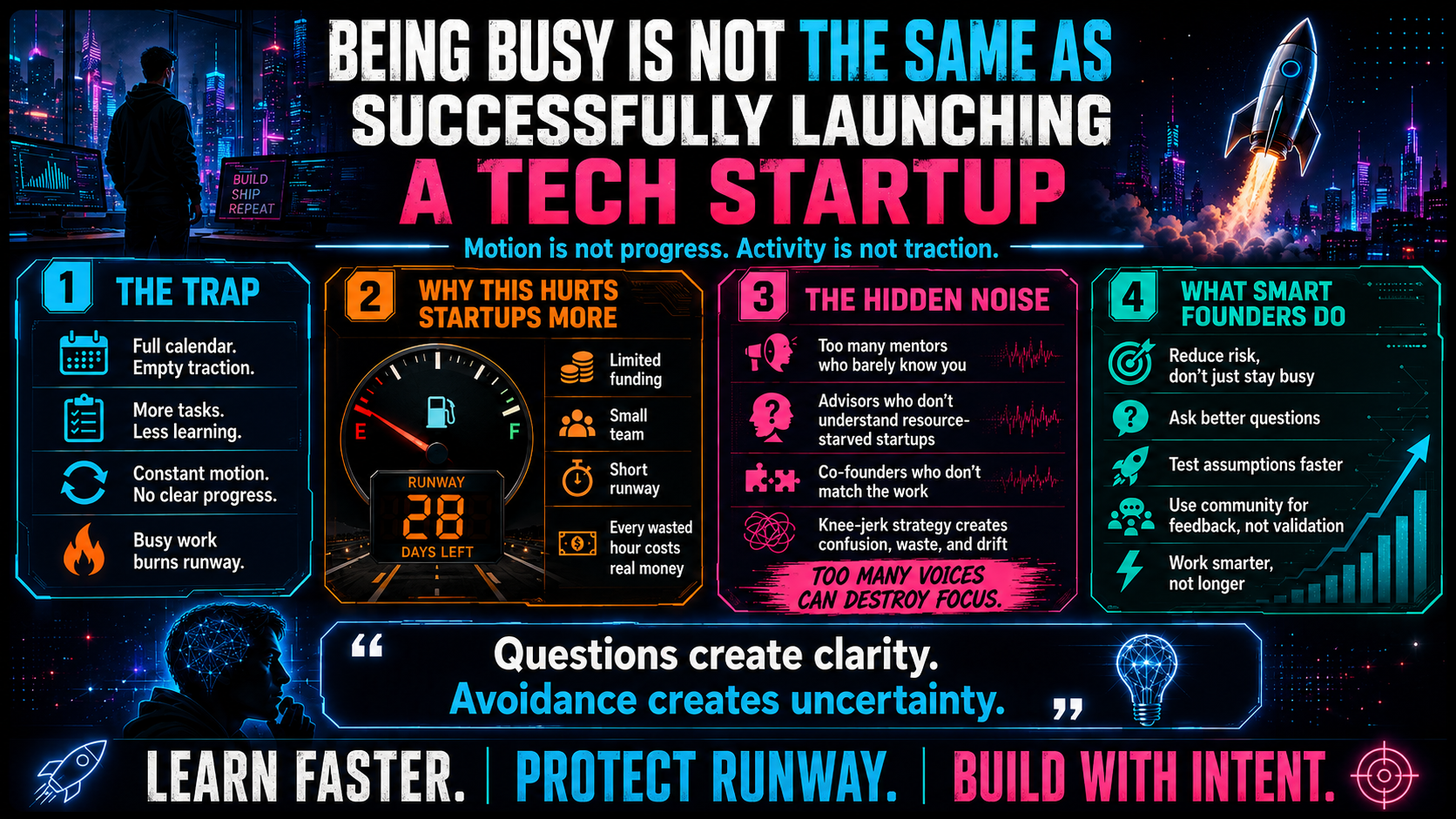
I remember times when I would end a long workday feeling exhausted and proud, only to realize I hadn’t moved any major goal forward. I had been active, but not effective. For example, I might spend hours perfecting a small design change or responding to every single message instantly, thinking I was being responsible. But I was avoiding the harder work, like improving the product strategy, finding better customers, or setting up systems that would save time later. I was avoiding working on things I didn’t enjoy. That’s the trap of being busy; it makes you feel like you’re winning when you’re standing still.
One of the biggest problems with busyness is that it rewards short-term thinking. You start chasing tasks instead of outcomes. You feel good checking things off a list, even if those things don’t really matter. But building a company requires patience and focus. The few things that take minutes add up to hours of waste. (Yes, I still fall into this trap. We all do.) It requires saying “no” to many things that feel important in the moment, so you can say “yes” to the few things that change the business’s future. That’s not easy, especially when everything feels urgent.
I also noticed that being busy often comes from a lack of clarity. When you don’t clearly define what success looks like, everything starts to feel equally important. So, you end up doing a little bit of everything instead of doing a lot of the right things. But when you are truly building, you know your priorities. You know what moves the needle. And you protect your time like it matters, because it does, and your startup’s success depends on it.
For a startup, this lesson is even more important because you usually do not have resources to waste. You do not have a huge team waiting to pick up the slack. You may have limited funding, a handful of people, and a runway that gets shorter with each passing hour. Every hour spent on something that does not reduce risk, improve efficiency, create value, produce learning, reach customers, or strengthen the company carries a real cost. Big companies can sometimes survive inefficiency. Startups often cannot.
The same holds for those founders who have way too many or the wrong voices around them. This problem becomes even more dangerous inside a startup because founders are surrounded by people offering advice. Mentors, advisors, investors, accelerators, friends, consultants, potential customers, and other founders all have opinions about what you should do next. Advice can be incredibly valuable. But more advice is not automatically better advice.
Having ten mentors who barely know you or your venture can create more confusion than having two mentors who deeply understand you and your venture. A mentor who meets you for 30 minutes every few months may offer a reasonable idea based on what they heard during that conversation. But they may not understand your customers, your technology, your team, your finances, your runway, your previous experiments, or why you already rejected the exact strategy they are suggesting.
The same problem happens with advisors who understand established businesses but have little experience with resource-starved startups. Their recommendations may make perfect sense for a company with 100 employees, a known brand, predictable revenue, and millions of dollars in operating capital. They can be disastrous for a startup with three people, six months of runway, and twenty assumptions still waiting to be tested.
Then there are co-founders. A title does not equal commitment. If one founder is investing 60 hours a week while another shows up only occasionally with opinions on strategy, priorities, product direction, or spending, the team can quickly become dysfunctional. Good co-founders need to invest the time required to understand what is happening before constantly changing direction.
This is where startups begin knee-jerking their way through strategy and tactics. One mentor says go left. An advisor says go right. A potential investor says change the business model. A customer asks for another feature. A co-founder suddenly wants a new market. Monday’s priority is abandoned by Thursday, and the team calls it all “agility.”
It isn’t agility if you aren’t learning.
Most of the time, it is just chaos.
Every unnecessary pivot consumes runway. It burns founder time, engineering hours, team energy, money, attention, and trust. When resources are limited, confusion is expensive. The goal is not to ignore advice. The goal is to develop a process for deciding which advice warrants an experiment, and which warrants a polite “thank you,” with your only action being to post the advice on a blank piece of paper. To eventually assess soon.
Becoming more efficient cannot simply mean working harder or longer. Eventually, another three hours at the laptop stop being an advantage. The better question is: How do I create more learning, progress, and value from the hours and resources I already have?
Start asking what only you can do. Ask what someone else could do better. Ask what can be automated, delegated, postponed, or eliminated. Ask which activity reduces the greatest risk in the business. Stop treating a longer task list as proof that you are accomplishing more.
And do not try to solve everything alone.
Plug into your entrepreneurial community. Talk openly about what you are working on. Explain the assumptions you are testing. Talk to other founders, experienced entrepreneurs, mentors, customers, technical experts, investors, and people who have already traveled part of the road ahead of you.
Then ask for feedback… Not validation… Feedback.
One great conversation can eliminate weeks of unnecessary work. One experienced entrepreneur can recognize a mistake you are about to make because they already made it ten years ago. One introduction can get you in touch with the right customer. One customer conversation can kill a bad assumption.
A startup community should not simply be someplace you go to occasional networking events. Used correctly, it becomes an extension of your team’s intelligence. Remember to invest in it as much as you get out of it.
The founder’s responsibility is not to blindly follow every mentor, advisor, customer, or investor. It is to listen, question, compare advice against evidence, run intelligent experiments, and make informed decisions. When you encounter an exceptionally difficult question or comment, don’t avoid it; ask clarifying questions for context. Avoidance may be to your detriment.
Lesson Learned
The shift for me came when I started asking a simple question at the end of each day: “Did I build something today, or did I just stay busy?” I stopped trying to do everything myself. I became more intentional about what I said yes to. And slowly, I realized I was getting more done by doing less.
For founders, I would add another question:
Did today’s activity increase our understanding and extend our opportunity to succeed, or did it just consume more of your runway?
You don’t win startup entrepreneurship by becoming the busiest person in the room. You win by learning faster, making better decisions, focusing limited resources on what matters, building the right relationships, and eliminating work that creates motion without value.
Don’t automatically work harder. Work smarter. Learn faster. Protect your runway… Surround yourself with a tech startup community by participating in Startup Zones events. See you soon.