



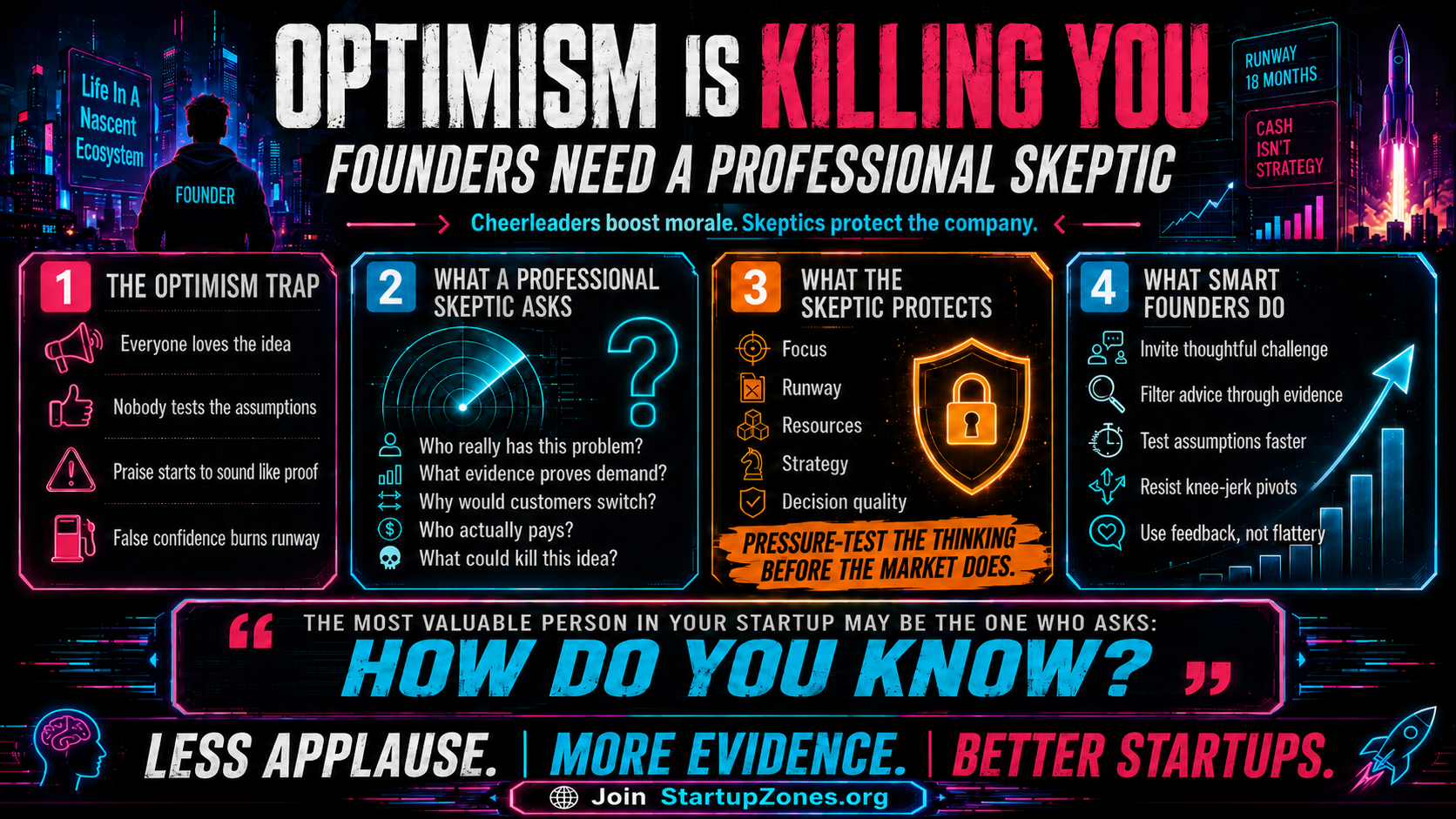

Optimism Is Killing You: Founders Need a Professional Skeptic
Startup founders in nascent ecosystems get a lot of encouragement. That is not a bad thing.
Starting a company is hard. There are plenty of days when nothing seems to work, customers disappear, technology breaks, funding gets tight, and the team starts questioning whether the whole thing makes sense.
Every founder needs people who believe in them.
But there is a point where encouragement stops helping. Sometimes what a founder needs most is someone willing to say, “I’m not convinced.”
Over the years, I have worked with many entrepreneurs who were surrounded by people telling them how great their idea was. Friends loved it. Family supported it. Other founders encouraged them. Mentors complimented the pitch. People at networking events nodded enthusiastically.
Everyone was cheering. The problem was that nobody was asking the uncomfortable questions.
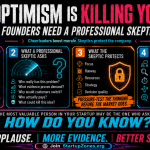
Who has this problem? How painful is it? What are customers doing today instead? Why would they switch? Who writes the check? What evidence do you have?
And one of my favorites: Which assumption you’re making, if it’s not true, would cause your startup to fail?
That is where a strategic skeptic becomes incredibly valuable.
A strategic skeptic is not someone who walks into the room looking for reasons your startup will fail. That person is simply a pessimist. A good strategic skeptic wants you to succeed badly enough to challenge your thinking before the market does.
There is a huge difference.
I have watched founders become defensive when someone questions their idea. They interpret a hard question as criticism. But the best founders eventually learn that a good question is a gift.
If somebody exposes a weak assumption during a mentoring session, you can test it. You can investigate it and validate/invalidate it. You can change direction or pivot if the evidence tells you that you should.
If a customer exposes that same assumption after you have spent two years and hundreds of thousands of dollars building around it, the lesson becomes much more expensive.
This is especially important in scalable technology startups.
Technical founders often have enormous confidence in technology because they have a deep understanding of it. They may have spent years developing it. There could be patents, research, prototypes, publications, or a major engineering breakthrough behind the company. That creates an understandable emotional attachment.
But great technology does not automatically create a great business.
A strategic skeptic may ask whether the customer cares about the technical advantage. They may question whether the problem is urgent enough to warrant changing vendors. They may challenge the pricing model, the unit economics, manufacturing assumptions, sales cycle, intellectual property strategy, regulatory path, or the amount of capital required to reach the market.
Those questions are not attacks on technology. They are attempting to protect the company.
One lesson I have learned from working with founders is that startup communities can sometimes become cheerleaders and, too often, significantly over-supportive to the detriment of the founder and the startup. That sounds strange, but it happens.
We want entrepreneurs to succeed, so we celebrate them. We organize pitch events. We introduce them to people. We applaud their progress. We tell them to keep going. All of that has value.
But an ecosystem that only cheers eventually becomes an echo chamber. Founders need encouragement, but they also need intellectual friction.
Someone needs to ask whether the traction is real. Someone needs to ask why the customer sales call produced compliments but no purchase. Someone needs to ask whether six mentors saying six different things is helping or simply creating noise. Someone even needs to put the brakes on a support organization so it doesn’t issue a press release for a startup that isn’t building momentum.
And someone needs to ask whether the founder is changing strategy because of evidence or simply because the last person they spoke with had a strong opinion.
That last problem is particularly dangerous.
I have seen startups knee-jerk their way through strategy. One advisor recommends enterprise customers. The next suggests small businesses. Someone says freemium. Someone else says premium pricing. An investor wants a different market. A mentor suggests another feature.
Monday’s strategy can look completely different by Friday. Suddenly, the startup is moving everywhere and going nowhere.
A strategic skeptic helps slow that chaos down. Not by slowing the company down, but by slowing the decision-making down long enough to ask one important question:
What evidence supports this change? That question can save months of wasted work.
The best strategic skeptics also understand the startup itself. They take time to understand the founder, technology, customers, team, resources, previous experiments, and current runway.
They are not dropping generic advice into a conversation and disappearing. They understand that a three-person startup with six months of runway cannot operate like a Fortune 500 company. That context can make a huge difference and may mean the difference between success and failure.
Advice without context becomes expensive very quickly.
The founder also has responsibility here. You cannot surround yourself only with people who agree with you and then complain when the market disagrees. Invite thoughtful disagreement.
Ask mentors to challenge your assumptions. Tell your team you want to hear what worries them. Ask customers what would prevent them from buying. Ask investors what they believe you are underestimating.
Then listen without immediately defending yourself.
You do not have to follow every suggestion. In fact, you should not. The goal is not obedience. The goal is better thinking.
A strong founder listens, asks questions, gathers evidence, runs experiments, and decides. The strategic skeptic is there to sharpen that process, not control it.
Every startup needs believers. You need people willing to encourage you when things get difficult and remind you why you started. But another person telling you, “Great idea!” may not be what saves your company.
The person who asks, “Who is the prospective customer with a hair-on-fire problem you can solve?” just might.
So, build a circle that does both.
· Find people who believe in you enough to cheer.
· Then find a few who care enough to challenge you.
Because sometimes the most valuable person in your startup community is not the person telling you how brilliant your idea is. It is the person willing to pressure-test your thinking before the market does.