




Funding Your Startup: Capital Literacy and Action
From a Hair-on-Fire Problem to a Working Prototype – Article 1 of 4
Over the years of mentoring and advising founders, I have found one aspect of the startup journey that has withstood the test of time: nearly every conversation eventually focuses on raising money.
While nearly every founder focuses on funding, far fewer understand what kind of money they should raise, when they should raise it, why they need it, and exactly what that money needs to accomplish. This difference can be critical to the success of their startup.
Funding a startup is not simply about putting cash in the bank. Capital should help you reduce uncertainty, validate assumptions, increase the company’s value, and extend your runway long enough to reach the next meaningful milestone.
Think of startup funding as a progression:
Idea. Derisk. Develop. Derisk. Validate. Derisk. Prove. Derisk. Fund. Reach product-market fit. Scale.
Notice how often derisk appears.
That is intentional.
At nearly every stage, your job is to reduce another layer of uncertainty before committing more time, money, people, or ownership to the venture.
The objective is not simply to raise as much money as possible. Every raise should have a strategic purpose and enough runway to accomplish a defined set of milestones.
The objective is to secure the right type of capital, at the right time, to accomplish the next set of milestones.
For Article 1, we are focusing on four early stages:
Problem / Idea → Validation → Technical Viability Proof → Prototype / MVP – Each stage should answer a very specific question.
- Problem / Idea: Is there a hair-on-fire problem worth solving?
- Validation: Who is the archetype, or right customer persona, who wants to solve it and pay for it NOW?
- Technical Viability Proof: Can we actually build it with the minimum technology and required feature set necessary to solve the problem? What will it cost in time and money?
- Prototype / MVP: Does the solution actually solve the problem and deliver the targeted value proposition for the archetype? And most importantly, how will we measure it?
These are not four boxes to check. There are four major layers of risk to mitigate.
Stage 1: Problem / Idea
The first milestone is not incorporation.
- It is not a logo.
- It is not a pitch deck.
- And it certainly is not raising venture capital.
The first question is:
Is there a hair-on-fire problem worth solving?
A hair-on-fire problem is more than an inconvenience. There are many of those in the archetype’s life. But these will not get the archetype to move, change behavior, or take on the risk of a startup.
It creates enough pain, cost, risk, lost revenue, inefficiency, danger, frustration, or missed opportunity that the customer feels pressure to do something about it.
That word NOW matters.
Founders frequently discover problems people would like solved someday.
That is very different from finding a problem somebody needs solved badly enough to change behavior, commit resources, and eventually spend money.
This is why starting with your technology can be dangerous.
Inventors often fall in love with what they can build.
Entrepreneurs need to become obsessed with the problem somebody desperately needs solved.
Ask:
- Who experiences the problem?
- What triggers it?
- How frequently does it happen?
- How expensive is it?
- What happens if they ignore it?
- What are they doing about it today?
- What does the current workaround cost?
- How frustrated are they with the alternative?
- What other problems are competing for their attention and budget?
The objective is not to convince people that your idea is brilliant. But rather, your job is to discover whether the pain already exists without you.
What You Need to Prove
- You need evidence that the problem is real, painful, frequent enough to matter, and costly enough to create action.
- You need to understand the consequences of doing nothing.
- You need to see whether customers are already trying to solve the problem and whether current alternatives leave important needs unmet.
- And you need some indication that enough customers may experience the problem to support the kind of scalable company you want to build.
- At this stage, you are not trying to prove the entire startup.
You are trying to answer a much more fundamental question:
Is this problem worthy of the next dollar and the next month of our lives?
Stage 2: Validation
Now the question gets harder.
You may have found a serious problem.
But who exactly cares enough to solve it and pay for it NOW?
This is where we define the archetype/persona.
The archetype is not simply an industry or a broad market.
“Healthcare” is not an archetype.
“Manufacturers” is not an archetype.
“Government” is not an archetype.
Even “hospital administrators” may be too broad.
Note: These are all market segments.
You are searching for the customer (decision-maker) profile most likely to experience the hair-on-fire problem, recognize its urgency, act, and have access to the money required to solve it.
The narrower and more precise you become, the faster you can learn.
Maybe your archetype is a production manager at a mid-sized aerospace manufacturer facing a specific defect issue.
Maybe it is an ophthalmologist performing a specific procedure.
Maybe it is a cybersecurity director (at a specific company size, location, industry, etc.) responsible for protecting a specific type of infrastructure.
That level of clarity changes everything.
Now, customer discovery becomes much more disciplined.
- What are they doing today?
- What does the problem cost them?
- Who owns the problem?
- Who feels the pain?
- Who controls the budget?
- Who approves the purchase?
- Who uses the solution?
- Who can block adoption?
- How quickly can they buy?
- What creates urgency?
- What causes them to do nothing?
- What must be true for them to switch from the current solution?
Do They Want It, or Are They Being Polite?
Founders hear phrases like:
- “That sounds interesting.”
- “I could see us using something like that.”
- “Keep me informed.”
- “That is really innovative.”
None of those statements validates a business. It supports your confirmation bias.
Validation becomes more credible when someone is willing to give you something scarce.
- Their time.
- Their data.
- Access to employees or facilities.
- Engineering resources.
- A letter of intent.
- A design partnership.
- A pilot commitment.
- An introduction to procurement.
- A deposit.
- Or ultimately, money.
- Compliments are cheap.
Commitment is evidence.
What You Need to Prove
At the validation stage, you should have growing evidence that you have identified the correct archetype, that the problem is important enough to drive action, and that the customer has both the motivation and a plausible mechanism to pay for a solution.
- You should understand the buyer, user, influencer, gatekeeper, and blocker.
- You should understand the existing alternatives, including doing nothing.
- You should also begin testing the value proposition and the problem’s economic scale.
- Is this a $1,000 problem?
- A $100,000 problem?
- A $10 million problem?
- Have they been the first to purchase a product or service that is not yet proven?
The answer dramatically changes the company you can build.
Stage 3: Technical Viability Proof
Only after we understand the problem and archetype should we become increasingly serious about building.
Now ask:
Can we actually build the minimum technology required to solve this customer’s problem?
Notice the wording.
Not:
Can we build everything we imagine?
And not:
Can we build the ultimate version of the product?
The question is whether you can develop the minimum technical capability and required feature set needed to deliver the targeted value proposition.
That distinction can save enormous amounts of time and capital.
Technical founders naturally want to build.
- More features.
- Better performance.
- More automation.
- More capability.
But every additional feature introduces development time, complexity, cost, integration problems, and new assumptions.
At this stage, complexity is the enemy.
You are trying to determine the minimum amount of technology required to prove that the problem can be solved.
What You Need to Prove
- Technical milestones vary by industry, but you may need to answer questions such as:
- Can the core scientific principle work?
- Can the software perform the required function?
- Can the sensor achieve the necessary accuracy?
- Can the hardware survive the customer’s environment?
- Can the system integrate with existing infrastructure?
- Can the device operate safely?
- Can the technology be manufactured?
- Are critical components available?
- Are there supply-chain dependencies?
- Are regulatory approvals required?
- What intellectual property needs protection?
- Do existing patents create freedom-to-operate concerns?
- What assumptions could make the venture impossible?
- What is the minimum required feature set?
And then comes the question founders sometimes avoid:
What will it cost in time and money to prove this?
Engineering time, materials, testing, software, facilities, outside contractors, certifications, regulatory work, prototype iterations, and contingency all need to be considered.
Technical feasibility without an understanding of cost and schedule is incomplete.
A technology may be possible to build yet remain commercially impractical.
Stage 4: Prototype / MVP
Technical viability answers:
Can we build it?
The prototype or MVP asks:
Does it actually solve the archetype’s hair-on-fire problem and deliver the targeted value proposition?
This is where technology finally meets reality.
A laboratory demonstration may prove the science.
It does not prove that the customer experiences meaningful value.
A working application may prove that the code functions.
It does not prove that the customer’s workflow improves.
A device may meet engineering specifications.
That does not automatically mean it solves the problem that motivated the startup.
This is why the prototype should be built around the value proposition, not around the founder’s feature wish list.
Build Only What You Need to Learn
The MVP is frequently misunderstood as a cheap or unfinished product. That misses the point. The MVP should contain enough functionality to test the most important assumptions with the target archetype.
What is the minimum feature set that allows the customer to experience the promised value?
- Anything beyond that should face scrutiny.
- Does this feature test an important assumption?
- Does the archetype require it?
- Does it materially affect the value proposition?
- Does it help us measure whether the problem was solved?
- If the answer is no, why are you spending scarce capital building it?
Measure the Value Proposition
- This is where founders need measurable proof.
- “We think customers like it” is not a metric.
- What exactly are you promising?
- Reduce inspection time by 50%?
- Increase throughput by 20%?
- Reduce false positives?
- Cut manufacturing scrap?
- Save four hours of labor every week?
- Increase diagnostic accuracy?
- Lower energy consumption?
- Reduce downtime?
- Increase yield?
- Generate additional revenue?
- Reduce risk?
Whatever value proposition you are selling should increasingly become measurable.
- Establish a baseline.
- Determine what the customer experiences today.
- Then measure what changes when your solution is introduced.
- That evidence becomes extremely important later.
- It can support pricing.
- It can strengthen a pilot proposal.
- It can make customer references credible.
- And eventually, it can help investors understand why customers will buy.
Note: The MVP is the minimal set of features that can deliver the value proposition that will motivate the archetype to purchase or test NOW. Not one feature more and not one feature less. The why is a lesson for another day.
Funding These First Four Stages
This is where capital literacy becomes practical. There is no single funding source that belongs exclusively to Problem / Idea, Validation, Technical Viability, or Prototype / MVP.
Many funding vehicles can be used across all four stages, depending on the company, eligibility, terms, timing, and opportunity.
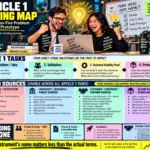
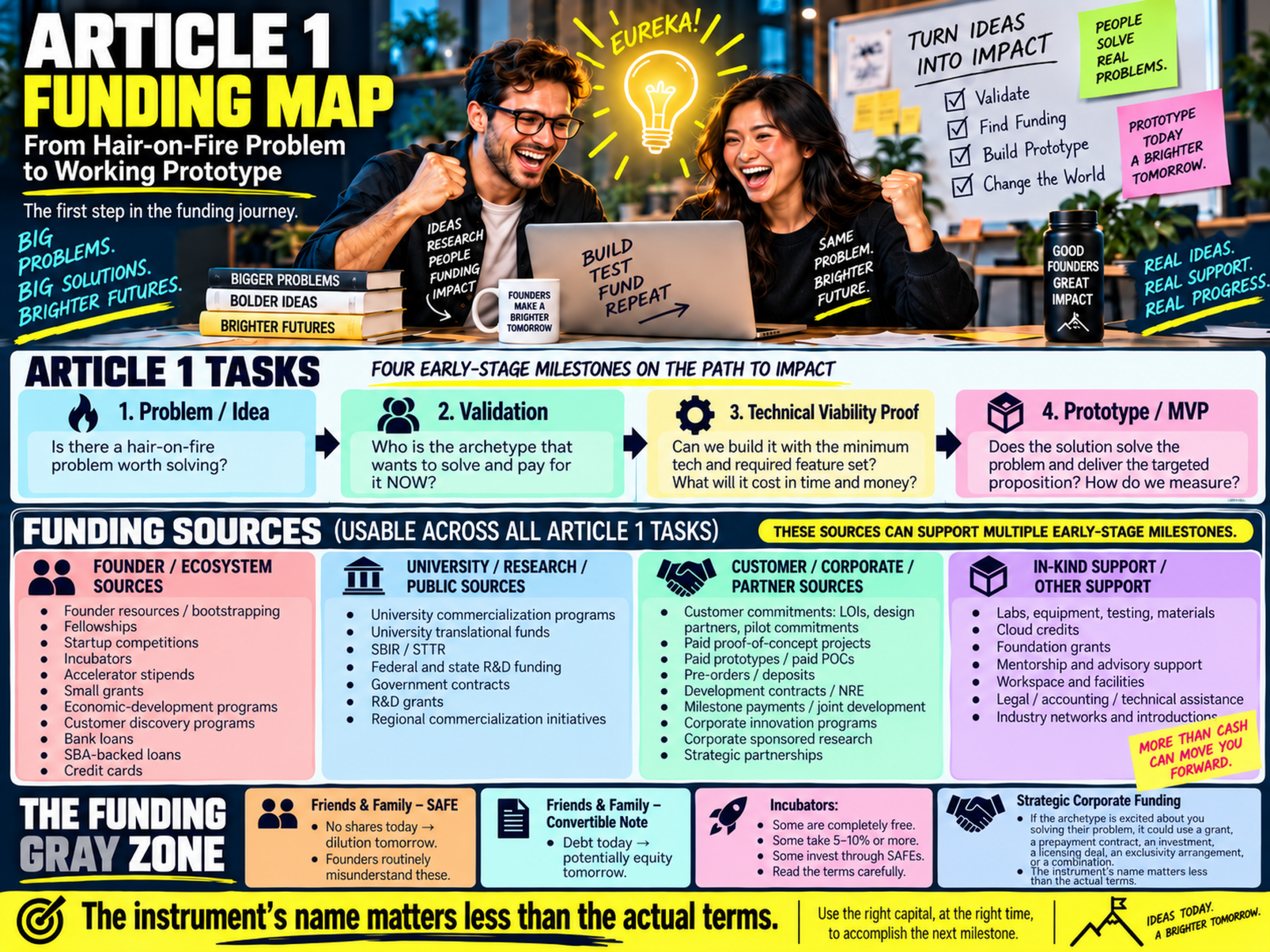
The accompanying Article 1 Funding Map is designed to show this visually.
Founders may use their own resources and bootstrapping. They may pursue fellowships, startup competitions, accelerator stipends, small grants, economic-development programs, customer discovery programs, bank loans, SBA-backed loans, or credit cards.
Universities, public agencies, and research organizations may provide commercialization programs, translational funding, SBIR/STTR support, federal or state R&D funding, government contracts, research grants, and regional commercialization programs.
Customers and corporate partners can become powerful sources of capital and validation through letters of intent, design partnerships, paid proof-of-concept projects, paid prototypes, pre-orders, deposits, development contracts, non-recurring engineering agreements, milestone payments, joint-development agreements, sponsored research, strategic partnerships, and corporate innovation programs.
Founders should also think beyond cash.
Laboratory access, equipment, testing, materials, cloud credits, workspaces, legal support, accounting, technical expertise, mentors, industry networks, and customer introductions can all extend the runway.
A dollar you do not have to spend can be just as valuable as a dollar you raise.
Understanding the Funding Gray Zone
Not every funding vehicle fits neatly into “dilutive” or “non-dilutive.”
Founders need to understand the gray zone.
A Friends & Family SAFE may provide cash without issuing shares today, but it can create dilution tomorrow.
A Friends & Family convertible note begins as debt but may convert into equity later.
An incubator may be completely free, charge fees, take 5–10% or more of the company, or invest through a SAFE.
Strategic corporate funding can be even more flexible.
If your archetype is excited about you solving their problem, a corporation may use a grant, prepayment contract, development agreement, investment, licensing deal, exclusivity arrangement, sponsored research agreement, or some combination of these approaches.
That leads to an important rule:
The instrument’s name matters less than the actual terms.
Before taking capital, understand exactly what you are giving up.
- Equity?
- Future equity?
- Interest?
- Repayment obligations?
- Exclusivity?
- Intellectual-property rights?
- Licensing rights?
- Board influence?
- Restrictions on future customers or investors?
Money is never just money. Terms matter. The reasons you want or need it also matter.
Capital Helps You Attain Milestones and Extends Your Runway
The Article 1 Funding Map contains many possible sources of capital.
The point is not to chase all of them. The point is to choose the capital that best helps you eliminate the next major risk. At this stage, every dollar should move you toward stronger answers to four questions:
Problem / Idea:
Is there a hair-on-fire problem worth solving?
Validation:
Who is the archetype that wants this problem solved and is willing to pay for it NOW?
Technical Viability Proof:
Can we build the minimum technology and required feature set necessary to solve the problem, and what will it cost in time and money?
Prototype / MVP:
Does the solution actually solve the problem and deliver the targeted value proposition for the archetype, and how can we prove it with measurable evidence?
If you cannot answer those questions, raising more money does not necessarily eliminate the risk. It may simply finance more assumptions. But if you can answer them, your startup has changed dramatically.
You started with an idea.
Now you have a defined problem, a defined archetype, evidence of urgency, a technically viable approach, an understanding of development cost and time, a minimum required feature set, a working prototype, and measurable evidence that the value proposition can be delivered.
That positions you for the next question:
Will your archetype customer use it, pay for it, and help us prove that this can become a business?
So, how much funding will it take to get you here? Answer this question, and you’re on your way.
Be on the lookout for next week’s Article 2: Pilot / Early Customer.