




Everybody Else Is Doing It: The Most Dangerous Words in Business
AI didn’t create corporate herd mentality. It just gave executives a very expensive new way to practice it.
There is a dangerous phrase hiding inside many executive meetings: “Everybody else is doing it.”
It rarely sounds that simple. Executives dress it up with words like transformation, disruption, optimization, modernization, efficiency, and competitive necessity. Consultants build presentations around it. Investors ask why you are not moving faster. Boards worry competitors are getting ahead. Following the crowd starts looking like leadership.
Artificial intelligence is giving us a front-row seat to this behavior.
Over the past several years, companies have announced AI strategies with enormous promises. AI would increase productivity, reduce costs, flatten organizations, automate customer service and coding, eliminate repetitive work, and allow businesses to operate with fewer employees.
Some of those promises are becoming reality. AI is an extraordinary tech.
However, along the way, something else happened.
Executives started conflating the ability to automate some work with the ability to eliminate the people doing it. That distinction is becoming expensive.
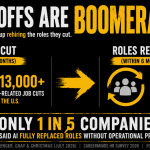
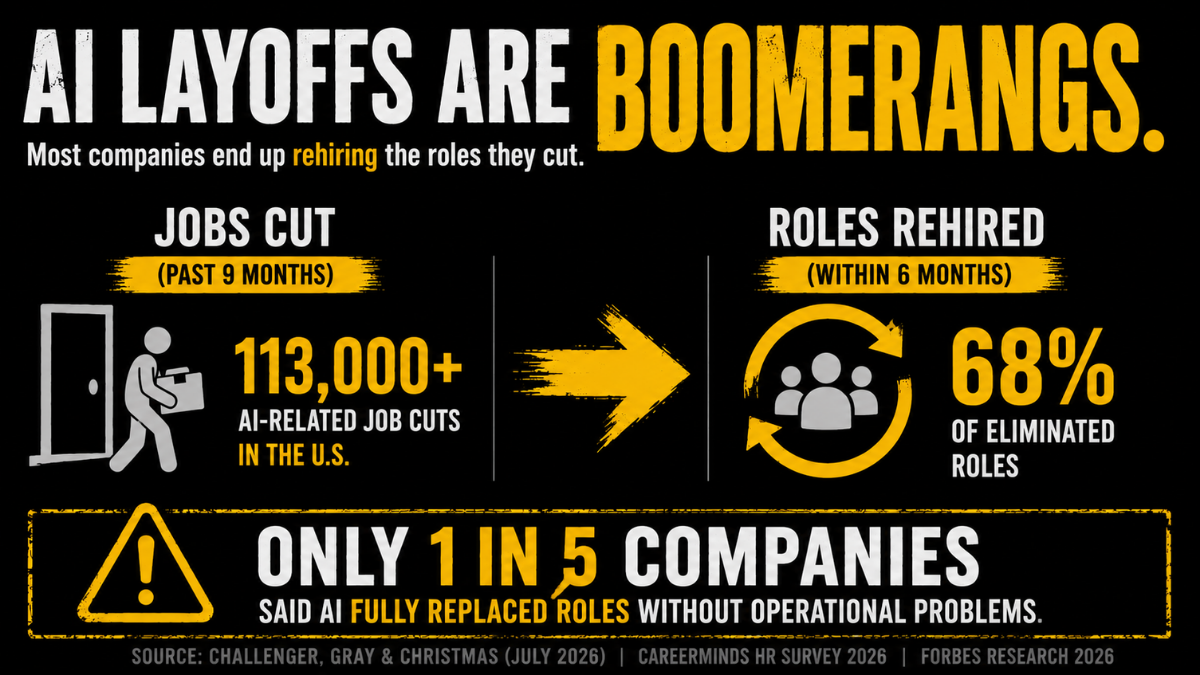
Through July 2026, U.S.-based employers announced 113,000 job cuts, with artificial intelligence specifically cited as a reason. AI became the leading reason for job cuts for five consecutive months. Those numbers do not mean every position disappeared exclusively because a machine took over. But they do show how quickly AI became part of corporate workforce decisions.
However, executives should pay close attention to the following: Companies are already reversing some of those decisions.
A 2026 survey of 600 HR professionals who had overseen layoffs found that 35.6% of organizations that conducted AI-related layoffs had already rehired for more than half of the roles they eliminated. Another 32.7% had rehired between 25% and 50% of those positions. More than half said they were rehired for roles that had been eliminated within six months.
Yes, the strategy is largely being corrected.
Why did those jobs come back? Because eliminating the employee did not necessarily eliminate the work.
The same research found that 32.9% of HR leaders reported losing critical skills and expertise after layoffs, while 28.1% said the remaining workforce could not fill the resulting knowledge gaps. Only 21.4% said AI fully replaced the eliminated roles without operational problems. A much larger 66.1% said AI replaced some tasks, but not complete jobs.
Think about 66.1%… Only about one in five said AI fully replaced the role without operational problems.
Jobs are bundles of tasks, relationships, judgment, history, exceptions, accountability, intuition, communication, and knowledge. AI might handle a large portion of the measurable tasks while completely missing the less visible work that keeps everything operating.
That less visible work is often institutional knowledge.
It rarely appears on a balance sheet. There isn’t usually a spreadsheet showing that one employee remembers why a supplier was changed twelve years ago, another knows which machine sounds different three days before it fails, or someone else knows that your largest customer expects something slightly different from what the contract technically says.
AI may never see that information because nobody wrote it down.
Then management eliminates those employees because an AI productivity presentation says their functions can be automated. Congratulations. You saved some salaries.
You may have also deleted part of your company’s memory. And then comes the second bill.
The same research found that nearly 31% of organizations said rehiring cost more than the layoffs had saved. Another large group reported that rehiring consumed most or all of the original savings.
That means companies can pay severance to remove people, experience lost productivity and knowledge, spend money recruiting replacements, retrain those replacements, and still end up back near where they started.
That isn’t a transformation. That’s paying tuition for following a trend before validating the assumptions.
This problem is bigger than AI.
Business history is filled with management movements executives rushed to copy: outsourcing, advanced manufacturing and other strategic functions offshoring, open offices, aggressive downsizing, innovation labs, agile transformations, remote work, return-to-office mandates, acquisitions, digital transformations, and now AI-first organizations.
Some worked brilliantly.
Some failed spectacularly.
Most worked under certain conditions.
But followers often copy the visible action without understanding the conditions that made the original strategy successful.
Frankly, this isn’t strategic planning.
Benchmarking should tell you what questions to ask. It shouldn’t tell you what decisions to make.
If another company eliminates management layers, that doesn’t mean you have too many managers. If your competitor automates customer support, that doesn’t mean your customers want to talk to a machine. If a giant corporation redesigns teams around AI, that doesn’t mean your company should do the same.
Their company isn’t your company.
Their customers aren’t your customers. Their people aren’t your people. Their technology isn’t your technology. Their financial runway isn’t yours.
Most importantly, their assumptions may also be wrong. This is where smaller companies should be paying especially close attention. A giant corporation can make a billion-dollar mistake and survive it.
A 75-person company may not survive the loss of six employees who understand its customers, systems, products, suppliers, equipment, and history.
The advantage smaller businesses have is that they can watch large companies pay for these experiments.
Use the lesson.
Don’t ask, “How many people can AI replace?”
Ask what problem you are trying to solve.
Break the work into tasks. Identify where AI genuinely improves performance. Determine where human judgment still matters. Pilot the technology. Measure what happens. Stress-test it. Ask employees what broke. Ask customers what changed. Calculate the real savings after implementation costs, supervision, mistakes, retraining, recruiting, and lost knowledge.
Then scale what’s likely to work, and don’t let what makes your core competencies walk out the door.
Being skeptical doesn’t make a leader anti-AI. It makes the leader responsible and strategic.
The strongest executives will aggressively explore AI while being equally aggressive about questioning assumptions. They will surround themselves with people willing to say, “Show me the evidence.” They will protect institutional knowledge while redesigning work. They will understand that sometimes refusing to follow the herd requires more courage than joining it.
Before adopting the next management trend, ask one final question:
Would we still make this decision if nobody else were doing it?
If the answer is no, you may not have a strategy. You may simply be drinking the Kool-Aid.