





Amazing Tech Founders Find Answers Faster
The dangerous idea I hear floating around entrepreneurship: the founder is supposed to know everything. The founder should know the market, the technology, the customer, the competition, how to raise money, how to build a team, how to set prices, how to sell the product, and somehow predict what happens next.
That sounds impressive. It is also nonsense.
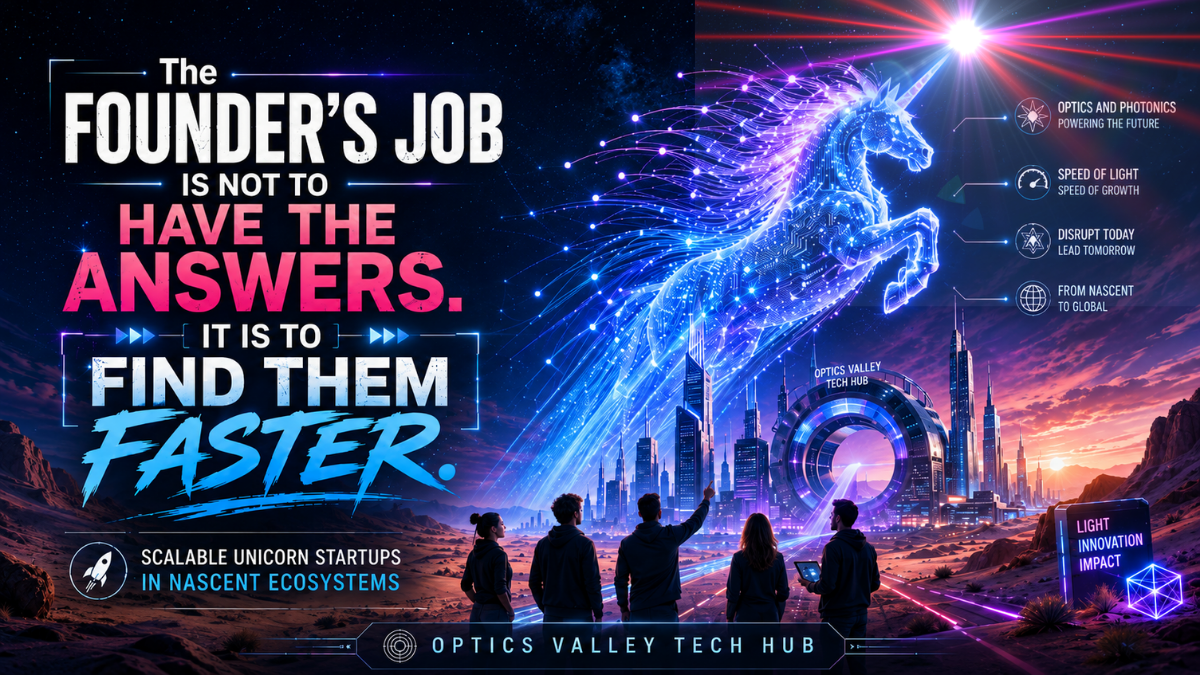
Great founders do not start companies because they already have all the answers. They succeed because they become exceptionally good at finding answers, mostly with discipline from their archetype. More importantly, they find them faster than everyone else.
A startup is not simply a smaller version of an established company. An established company usually has customers, processes, historical data, products, employees, and some understanding of how its market works. A startup begins with assumptions. You assume a customer has a problem. You assume the problem matters enough to solve. You assume your solution is better than the alternatives. You assume someone will pay for it. You assume you know who that someone is, how to reach them, and how to build a business around them.
That is a lot of assumptions.
The founder’s job is not to defend those assumptions. The founder’s job is to attack them.
One of the strongest traits a founder can develop is curiosity. Curious founders ask questions. Why does the customer do it that way? What happens when this problem occurs? How much does the problem cost? How big a problem is it? Is this a hair-on-fire problem? What have they already tried? Why didn’t that work? Who makes the buying decision? What would have to happen for them to change?
Notice what those questions have in common. None of them begins with, “Let me tell you about my product.”
Early founders often spend too much time explaining and not enough time listening. They want customers to understand their brilliance. Great founders want to understand the customer’s world. That requires humility.
Humility does not mean lacking confidence. It means having enough confidence to say, “I don’t know yet.” Those three words can save a startup an enormous amount of time and money.
Early-stage entrepreneurship is really a race to learn. Every assumption is a question waiting for evidence. Customer interviews produce evidence. Experiments produce evidence. Prototypes produce evidence. Sales calls produce evidence. Failed sales calls produce evidence. A customer who refuses to use your product provides evidence. A customer saying, “I need this right now,” produces very different evidence.
The process is simple: ask, test, listen, learn, change, and repeat. Furthermore, this is what we train during our Agage Accelerator program.
A founder who goes through that cycle ten times while a competitor is still polishing a pitch deck has an enormous advantage. Speed does not mean recklessness. It means shortening the distance between a question and an evidence-based answer.
This is also where the early team becomes critical.
Founders sometimes recruit people who think exactly like they do. That feels comfortable, but it can also be dangerous. Your first employees and co-founders should not simply validate your thinking. They should improve it. Someone on the team needs to be willing to ask, “Why do we believe that?” “What evidence do we have?” “Did the customer actually say that?” “Are we solving the real problem or the problem we wish they had?” and perhaps most importantly, “What would prove us wrong?”
A strong startup team creates productive tension. Engineering sees one thing. Sales sees another. Customers see something different. Operations may uncover another problem entirely. Put those perspectives together, and the company becomes smarter. Shut them down because “the founder knows best,” and you create a very expensive echo chamber.
This is also why good mentoring is invaluable. So, know the difference between an advisor and a mentor.
Many founders expect mentors to tell them what to do. Sometimes that is useful. Experience matters. Expertise matters. Advice matters. But great mentors often do something even more valuable: they ask questions the founder has not considered.
Why? What makes you believe that? Tell me more… Who have you talked to? What did you learn? What changed your thinking? What evidence would cause you to abandon this idea?
Those questions can be uncomfortable. That is often the point, and I use them for that reason.
A mentor’s job should not always be making the founder feel smart. Most of the time, the greatest value a mentor provides is exposing the giant hole sitting in the middle of the founder’s strategy. The mentor can point to the hole, but the founder must still investigate it. That is where learning happens.
Founders also underestimate the power of community, especially in a nascent tech hub.
A startup ecosystem should be more than networking events, business cards, pitch competitions, and LinkedIn connections. A great startup community becomes a giant learning network. One person knows manufacturing. Another understands intellectual property. Someone knows government contracting. Someone has built sales teams. Another founder just made the mistake you are about to make. A mentor knows the customer you need to meet. An investor sees a weakness in your business model. An engineer sees a technical risk nobody else notices.
The founder who engages deeply with that community can tap into decades of experience without personally spending decades acquiring it.
But there is a catch.
You must leave your home, office, or lab. You must ask. And then you must listen.
Make yourself vulnerable. Founders are going to be wrong. A lot. That should not be embarrassing. Staying wrong for twelve months because you refused to question yourself should be.
Imagine two startups that begin with the same incorrect assumption. Founder A spends a year building around it. Founder B discovers the mistake in three weeks, changes direction, tests another assumption, learns again, and moves forward.
Who is ahead?
The founder who was willing to be wrong.
That is entrepreneurship. Not knowing. Testing. Learning. Adjusting. Moving.
The strongest founders I have encountered are rarely the people trying hardest to prove how much they know. They are usually the people asking the best questions. They surround themselves with smart people. They talk to customers constantly and develop empathy for them so they can walk in their shoes. They invite disagreement. They seek mentors who challenge them. They build early teams that think rather than agree. They engage with their communities. And when new evidence tells them they are wrong, they change. They test their stories all of the time.
That is not a weakness. That is startup leadership. That is a future mentor who is needed to advance a nascent ecosystem.
You do not need to have all the answers. You never will.
Your job is to build curiosity, humility, an early team, mentors, experiments, and a community that helps you find them.
Then find them faster than everyone else.