


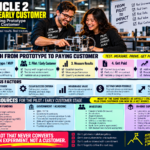

From a Working Prototype to a Paying Early Customer
Funding Your Startup: Capital Literacy and Action
In Article 1, we worked through four major layers of startup risk:
Problem / Idea → Validation → Technical Viability Proof → Prototype / MVP
Welcome to Article 2: Pilot / Early Customer.
This is where your startup begins moving from technical evidence toward commercial evidence.
A working prototype demonstrates that your solution can deliver value.
A successful pilot begins to demonstrate that someone outside your startup believes the value is important enough to invest time, resources, reputation, and, hopefully, money in it.
Remember the lesson from Article 1:
Commitment is evidence.
Now we are going to find out how much commitment actually exists.
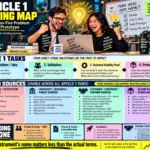
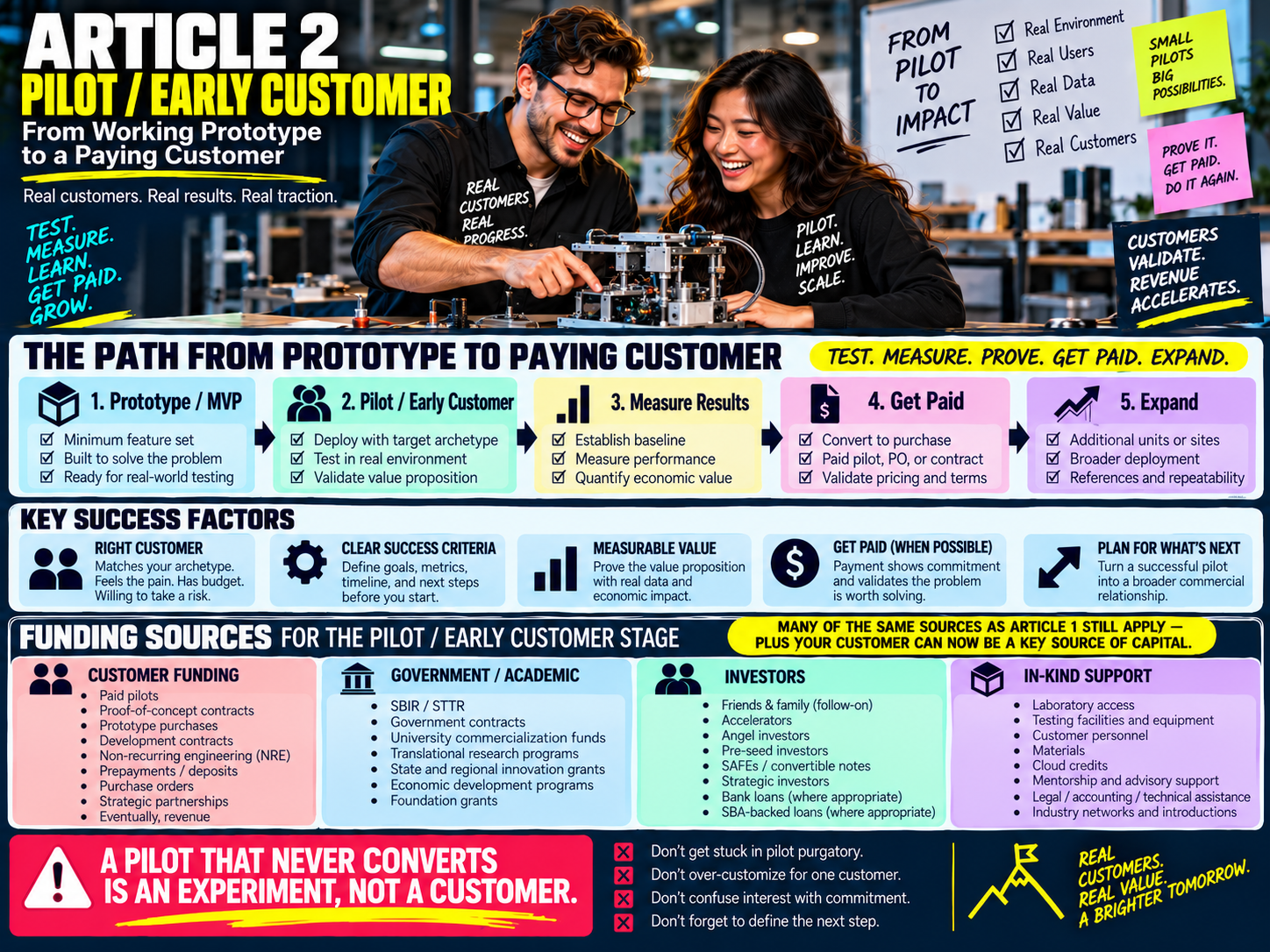
Stage 5: Pilot / Early Customer
A Pilot Is an Experiment, Not a Trophy
Founders love announcing pilots. (In nascent ecosystems, most of the time, service providers push press releases to demonstrate their own momentum versus the milestone momentum of the startup. Be careful, you start too early, and you lose gas; it may be difficult to recover.)
“We have a pilot with a major corporation.”
Great.
But what exactly are you proving?
A pilot should be designed as a structured experiment. The customer places your solution into the environment where the actual problem occurs. Then both sides determine whether the solution produces the measurable value you predicted.
- Can it work outside your laboratory?
- Can real people use it?
- Can it integrate into existing workflows?
- Can it operate consistently?
- Does it create the expected improvement?
- Does that improvement matter economically?
And if it works:
Will the customer continue to actively use and buy ?
Getting a pilot is not the finish line. The pilot is another step in the derisking process.
Don’t Take Just Any Customer
One of the biggest temptations at this stage is taking whatever the customer says yes to. Be careful. Your first pilot should ideally involve someone who closely matches the archetype/persona you identified during validation. Remember why you selected the archetype.
You are not trying to prove that someone somewhere might use your technology. You are trying to prove that a specific type of customer with a specific hair-on-fire problem will consistently value your solution.
An ideal early customer:
- Experiences the problem intensely.
- Recognizes the urgency of solving it.
- Has already attempted to solve it.
- Has something meaningful to lose by doing nothing.
- Has access to the budget. Can they purchase on a procurement card (P-Card)?
- Has the authority or influence to move a pilot forward.
- Can provide the environment, people, equipment, or data required for testing.
- Understands the risks of working with an early-stage company.
- Is willing to provide meaningful feedback.
- And is willing to act NOW.
There is another characteristic worth looking for.
Has this customer previously purchased or tested products from startups or other unproven vendors? (In other words, are they an innovator or an early adopter?)
Some organizations say they embrace innovation. Their procurement process says otherwise. Their profile is that of the early majority. Good luck in getting a commitment out of them.
Your ideal early customer understands that an MVP will not be perfect and is willing to accept some calculated risk because the problem is painful enough to justify trying something new.
Prove That They’re Your Champion
Companies do not buy products. People inside companies make buying happen. Your early customer is your champion. That person understands the problem. They feel the pain. They see the potential value immediately. And they are willing to stick their neck out.
A strong champion:
- Likely to be the decision-makers.
- Or they will promote you to the decision maker.
- Help secure access to facilities.
- Find internal budget.
- Get engineering involved.
- Explain procurement requirements.
- Help navigate cybersecurity.
- Coordinate users.
- Help legal understand the project.
- Defend the pilot when something goes wrong.
- Push internally for the next step.
But your champion may not be the economic buyer. Do not confuse enthusiasm with authority.
You still need to determine other elements. Some of which are as follows:
- Who owns the problem?
- Who controls the budget?
- Who signs the agreement?
- Who uses the solution?
- Who approves technology?
- Who controls procurement?
- Who handles cybersecurity?
- Who controls the data?
- Who can stop the project?
- Who decides whether a successful pilot becomes a purchase?
Article 1 helped you understand these roles conceptually. The pilot shows you how they behave in reality.
Define Success Before You Start
One of the most expensive mistakes founders make is starting a pilot without agreeing on what success means. Everyone is excited. The technology gets installed. The testing starts… Three months later, someone asks:
- “So, did it work?”
- “So, what’s next?”
- That’s when everything stalls,
Before the pilot begins, you and the customer should understand:
- What problem are we solving?
- What is happening today?
- What is the baseline?
- What result are we targeting?
- What will we measure?
- How will we measure it?
- Who owns the measurement?
- What data will be collected?
- How long will testing continue?
- What operating conditions are required?
- What represents failure?
- What represents success?
And then ask the question that is often forgotten:
If the pilot succeeds, what happens next?
That question should be discussed before the pilot begins. Does success lead to:
- A purchase?
- A purchase order?
- A commercial contract?
- A subscription?
- Additional units?
- Deployment at another location?
- A larger paid pilot?
- A license?
- A production agreement?
- A long-term services agreement?
A technically successful pilot with no commercial next step may leave you exactly where you started. Actually worse due to the opportunity costs of time and capital commitments. In this case, your investment is 2X what you thought you committed to.
Remember the Targeted Value Proposition
Suppose your targeted value proposition is:
Reduce inspection time by 50%.
Before using your technology, inspection requires ten hours. After deployment, it requires five. This is great!
You have demonstrated technical value. Now it’s time to go further. What are those five hours worth?
Does the customer:
- Reduce labor costs?
- Increase throughput?
- Eliminate overtime?
- Reduce machine downtime?
- Ship faster?
- Increase production?
- Improve quality?
- Reduce scrap?
- Reduce warranty claims?
Now you are translating your solution into economic value. That becomes increasingly important because your customer is not ultimately buying features. They are buying the result.
Measure Before, During, and After
“We think the pilot went well,” but this is not evidence. Measure it:
- Start with the baseline.
- What happens today without your solution?
- Then measure performance during the pilot.
- Finally, compare the results.
Maybe you promised to:
- Reduce inspection time.
- Increase throughput.
- Lower energy consumption.
- Reduce false positives.
- Improve yield.
- Reduce downtime.
- Increase diagnostic accuracy.
- Prevent equipment failures.
- Reduce labor.
- Improve safety.
- Increase revenue.
- Reduce risk.
Whatever you promised should increasingly become measurable.
Before… During… After….
That evidence can eventually support:
- Validation… Proof…
- Pricing.
- Case studies.
- Customer references.
- Sales conversations.
- Investor discussions.
- Grant applications.
- Strategic partnerships.
- Future pilots.
- Purchase decisions.
A strong pilot creates evidence you can reuse.
Do They Pay?
Now we reach one of the most uncomfortable questions for founders.
Will the customer pay?
Whenever practical, your goal should be a paid pilot unless you’re operating a freemium model and monetizing in another strategic way. In this case, measured active use may give you proof.
Why?
- Because payment represents commitment.
- The customer has moved beyond compliments.
- They found the budget.
- They justified the expenditure.
- Someone approved it.
- Someone may have signed a contract.
- Procurement may have become involved.
- Money changed hands.
- That tells you something important.
- The customer believes the problem is worth spending money to solve.
Remember:
Commitment is evidence. And money is one of the strongest forms of commitment.
A Paid Pilot Also Tests Pricing
A paid pilot begins teaching you something else.
How much is solving this problem worth?
Will the customer pay:
- $5,000?
- $25,000?
- $100,000?
- $500,000?
- More?
Will they pay for:
- The pilot?
- Engineering?
- Installation?
- Customization?
- Hardware?
- Integration?
- Training?
- Testing?
- Data analysis?
Understanding the economic impact of the problem gives you a much stronger foundation for determining what the solution may be worth.
Does a Free Pilot Ever Make Sense?
Yes.
Sometimes.
A free or subsidized pilot may make strategic sense if the customer provides something of equal value.
Maybe they provide:
- Expensive laboratory access.
- Specialized equipment.
- Engineering resources.
- Valuable datasets.
- Regulatory expertise.
- Testing facilities.
- Materials.
- Technical personnel.
- Access to users.
- Credibility in the market.
- Introductions to additional customers.
Perhaps completing the pilot creates the evidence required to win a government contract or certification. Those contributions have value.
The important question is:
What is the customer committing to and at what cost?
If your startup is spending $100,000 and the customer contributes nothing but permission to experiment on their property, look carefully at the economics.
That may not be a partnership. You may simply be funding their experiment.
Don’t Become Their Free Engineering Department
This brings us to another dangerous part of pilots.
The customer says:
“Could you add this?”
Then:
“What about this feature?”
Then:
“We really need this capability too.”
Suddenly, your carefully designed MVP begins growing.
One feature becomes five.
Five becomes fifteen.
Your engineers become consumed by one customer’s requests.
You may feel like you are making progress because everyone is busy.
But ask:
Are we improving the product for our archetype, or building a custom product for a single company?
Every requested feature should face scrutiny.
- Does our archetype need it?
- Does it improve our targeted value proposition?
- Will multiple customers need it?
- Does it help solve the hair-on-fire problem?
- Does it remove a major adoption barrier?
- Is the customer willing to pay for it?
If the feature primarily benefits one customer, consider charging for it.
That could include:
- Development fees.
- Integration fees.
- Customization fees.
- Non-recurring engineering — NRE.
- Milestone payments.
- A separate development agreement.
Customers can absolutely help shape your product.
But they should not accidentally turn your scalable startup into an unpaid consulting company.
Funding the Pilot / Early Customer Stage
Article 1 introduced many funding sources that founders can use across the first four stages. Many of the same sources can continue to fund your company during the Pilot/Early Customer stage.
But something important begins to change. Your customer can increasingly become a source of capital.
That capital might come through:
- Paid pilots.
- Proof-of-concept contracts.
- Prototype purchases.
- Development contracts.
- Non-recurring engineering agreements.
- Prepayments.
- Deposits.
- Purchase orders.
- Milestone payments.
- Sponsored development.
- Joint-development agreements.
- Licensing agreements.
- Government procurement.
- Corporate innovation programs.
- Strategic partnerships.
- And eventually, recurring customer revenue.
This is powerful because customer capital can accomplish two things at once.
- It extends your runway.
- It validates demand.
- It derisks your startup/deal.
A grant may prove that a government program believes your research deserves funding. An investor may demonstrate that they believe your company could become valuable. A paying customer proves something different.
Someone believes the problem is important enough to spend money on solving it. That is a major milestone for the company, and in the form of derisking and investment in your startup.
Other Sources of Capital Still Matter
Customer funding does not mean grants, programs, investors, or strategic partners suddenly disappear.
Depending on the venture, founders may continue using:
- Founder capital.
- R&D grants.
- SBIR / STTR.
- Government contracts.
- University commercialization funding.
- Translational research funds.
- State or regional innovation funding.
- Foundation grants.
- Economic-development programs.
- Corporate innovation funding.
- Accelerators.
- Angel investors.
- Pre-seed investors.
- SAFEs.
- Convertible notes.
- Strategic investors.
- Bank financing where appropriate.
- SBA-backed financing where appropriate.
And in-kind resources will reduce your need for institutional investors:
- Testing facilities.
- Laboratory access.
- Engineering support.
- Customer personnel.
- Equipment.
- Materials.
- Cloud credits.
- Professional services.
- Introductions.
A dollar you do not have to spend remains a dollar that extends your runway.
Understanding the Funding Gray Zone
The Funding Gray Zone we introduced in Article 1 becomes even more important here.
Strategic corporations may become interested once your technology reaches the pilot stage. That can be extremely valuable, but understand and drive the terms.
A strategic corporation may offer:
- A paid pilot.
- A prepayment.
- A grant.
- A development agreement.
- Sponsored research.
- An investment.
- A licensing agreement.
- A joint-development agreement.
- An exclusivity agreement.
- Or some combination.
Before accepting the money, understand what you are giving up.
Ask:
- Do they receive equity?
- Future equity?
- Intellectual-property rights?
- Ownership of jointly developed IP?
- Exclusivity?
- In what market?
- For how long?
- Can you sell to competitors?
- Do they receive preferential pricing?
- Licensing rights?
- A right of first refusal?
- Warrants?
- Board influence?
- Restrictions on future investors?
- Restrictions on a future acquisition?
The instrument’s name matters less than the actual terms.
A large check can extend your runway. Bad terms can limit your future. But both are critical and must be understood.
Beware of Pilot Purgatory
There is another place startups get trapped.
I call it Pilot Purgatory.
- Pilot 1.
- Pilot 2.
- Pilot 5.
- …
- Pilot 10.
Everybody seems interested… Everyone wants to test your technology… Your team is busy… Engineering is overwhelmed… Customers are giving you feedback… It feels like progress…Every pilot requires customization… Every customer wants something different… You are running constantly but not moving much closer to a repeatable business… But almost nobody converts.
Revenue stays low. These are all warnings.
If pilots repeatedly fail to convert, ask why.
- Is the problem really hair-on-fire?
- Is the archetype wrong?
- Is the value proposition weak?
- Is implementation too difficult?
- Is the solution too expensive?
- Is the user different from the buyer?
- Does the customer have a budget?
- Is the sales cycle much longer than expected?
- Does the product require too much behavior change?
- Are you selling a nice-to-have rather than a need-to-have?
- Are customers willing to test but unwilling to buy?
Those questions may be painful. Ask them anyway. Remember what this entire capital roadmap is about. Derisking.
Discovering that something is wrong while conducting five pilots is far less expensive than discovering it after raising and spending $10 million.
Remember the adage: “Fail Fast.” Not because you want to fail, but because you are aware of opportunity costs and the possibility of a pivot.
What You Need to Prove
By the end of the Pilot/Early Customer stage, you should have stronger evidence across four areas.
The Customer
- Did you select the correct archetype?
- Was the hair-on-fire problem present?
- Was there enough urgency to act?
- Did you find an internal champion?
- Did you identify the economic buyer?
- Did you understand how the organization purchases?
- Was the customer willing to take a risk on an early-stage company?
The Product
- Did the solution work in the customer’s actual environment?
- Did users successfully operate it?
- Did it integrate into their workflow?
- Was performance repeatable?
- Did you identify critical missing functionality?
- Could you deliver the solution without excessive customization?
The Value
- Did you deliver the targeted value proposition?
- Did you establish a baseline?
- Did you measure the result?
- Could the customer quantify the economic value?
- Was the value significant enough to justify purchasing?
The Commercial Commitment
- Did the customer contribute meaningful resources?
- Did they pay?
- Will they purchase?
- Will they expand?
- Will they renew?
- Will they introduce you to another potential customer?
- Will they serve as a reference?
- Is there a clear next commercial step?
These are the risks your capital should help eliminate.
Capital Helps You Attain Milestones and Extends Your Runway
At this stage, your objective is not simply:
Get a pilot.
The milestone is much more meaningful:
Put the solution into the archetype’s real environment, prove that it delivers measurable value, establish willingness to pay, understand how the customer buys, and create a path toward a commercial relationship.
Imagine two founders speaking with an investor.
Founder A says:
“We have a working prototype and several companies are interested.”
Founder B says:
“We deployed with our target archetype. The solution reduced their inspection time by 42%. That represents approximately $180,000 in annual savings. They paid us $35,000 for the pilot and have approved deployment at three additional facilities.”
Those are not the same startups. The second founder has removed significantly more risk. And that is precisely what each stage of your capital strategy should accomplish.
The Goal Is Not the Pilot
The goal is not to say:
“We landed a pilot.”
The goal is to say eventually:
“Our archetype had the hair-on-fire problem we predicted. They committed resources to solving it. Our product worked in their environment. It delivered the measurable value proposition we promised. They paid us. And they want more.”
Now that is progress.
You entered Article 2 with a working prototype. You should leave it with growing evidence of commercial value. Now the next step… Can you do it again?
Can another archetype customer experience the same problem, buy the same solution, receive similar value, and move through a similar sales and delivery process?
Can you repeat the process without rebuilding the product and reinventing your company every time?
That is the next major layer of risk mitigation. Repeatability. And repeatability leads us toward one of the most important milestones in a scalable startup: reaching Product-Market Fit.
So, how much funding and runway will it take to move from your working prototype to measurable customer value and a real commercial commitment?
Answer that question, and you are ready for the next step. Be on the lookout for next week’s Article 3: Repeatability / Product-Market Fit.