



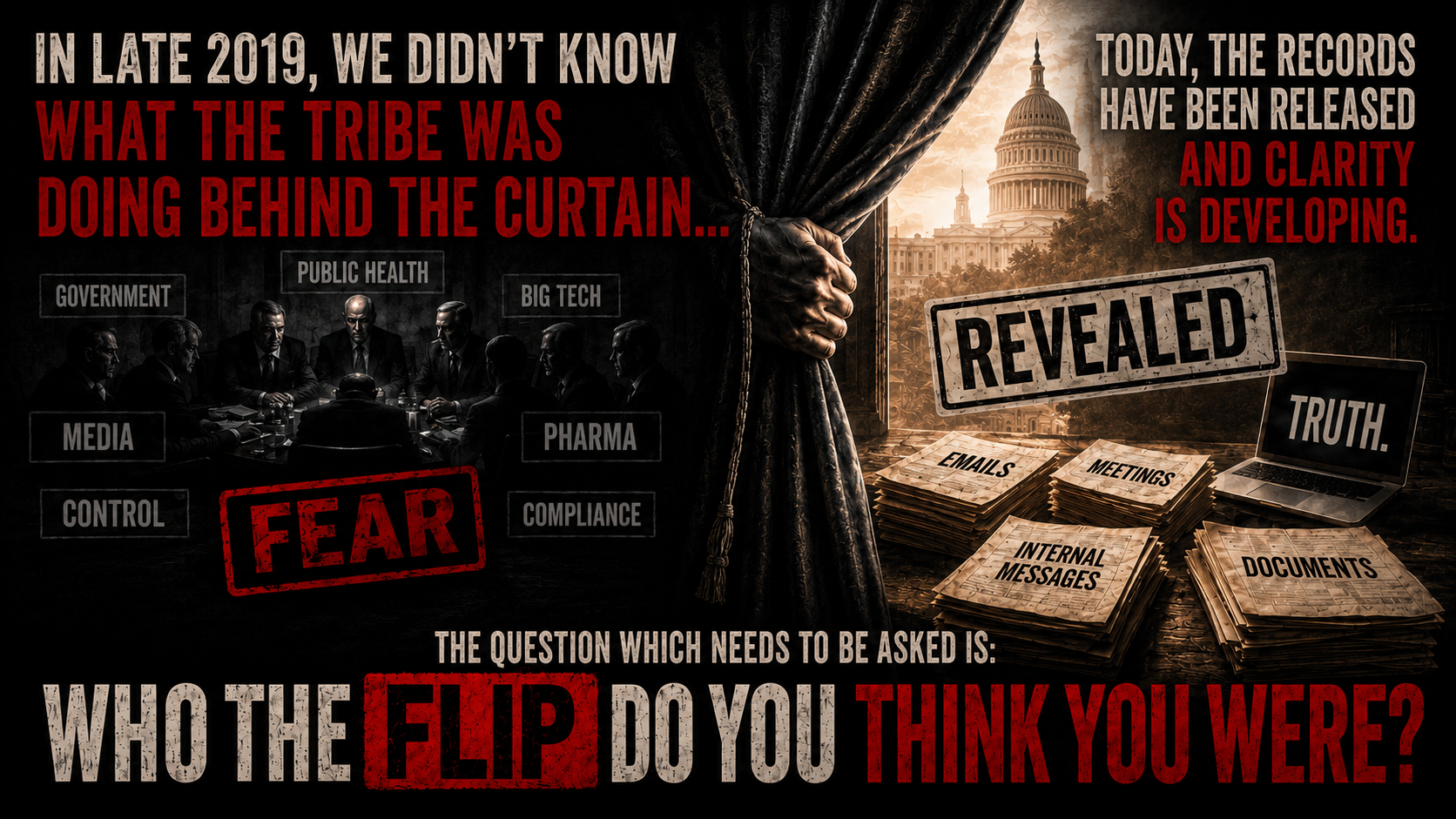

Big Dangers of Institutional Tribal Behavior Exposed by COVID-19
WHO THE FLIP DO YOU THINK YOU WERE?
The most disturbing lesson of the COVID-19 pandemic may not be that government officials made mistakes. Mistakes were inevitable. A new virus was spreading, hospitals feared collapse, data were incomplete, and leaders had to act before every fact was known.
The deeper failure was what happened after uncertainty became institutional doctrine.
Government agencies, public-health officials, universities, scientific organizations, media companies, technology platforms, employers, and political leaders gradually formed a self-reinforcing information system. Certain conclusions were elevated to a responsible, scientific, and morally acceptable status. Competing conclusions were often labeled dangerous, selfish, uninformed, or false before the evidence justified such certainty.
This was not merely poor communication.
It was institutional tribalism during a global emergency.
No secret command center was required. There did not need to be one person coordinating every official, scientist, editor, and technology executive. The system worked because powerful institutions developed compatible incentives. Government officials wanted compliance. Health agencies wanted unified messaging. Journalists wanted authoritative sources. Technology platforms wanted protection from accusations that they were spreading harmful content. Universities and researchers wanted grants, access, publication, prestige, and professional security.
Each institution reinforced the others.
The result was a machine capable of turning uncertainty into certainty, policy into science, disagreement into misinformation, and dissenters into social contaminants.
When “Follow the Science” Became “Follow the Tribe”
Science is not a sacred scroll delivered by authorities. It is a process of argument, testing, failure, correction, and discovery.
During the pandemic, however, “follow the science” often became something very different:
- Follow the approved scientists.
- Accept the approved conclusions.
- Repeat the approved language.
- Do not ask questions that might reduce compliance.
This shift was dangerous because many pandemic decisions were not purely scientific. They involved ethics, economics, education, law, psychology, and civil liberties.
Science could estimate whether reducing contact might slow transmission. It could not decide how long children should be excluded from classrooms.
Science could measure vaccine effectiveness. It could not independently determine whether workers should lose their jobs for refusing a medical intervention.
Science could examine whether a laboratory-related origin was possible. It could not justify humiliating people merely for asking the question.
Science could identify risk. It could not decide how much freedom society should surrender or who should bear the cost.
Those were political and moral decisions. Yet many leaders hid them behind a laboratory coat.
Politicians said they were merely following experts. Experts said they were only offering guidance. Employers said they were following government recommendations. Platforms said they were enforcing expert consensus. Media organizations said they were reporting what trusted institutions told them.
Everyone exercised influence.
Almost no one wanted ownership of the consequences.
The System Did Not Merely Answer Questions. It Decided Which Questions Were Permitted.
The origins of COVID-19 provide one of the clearest examples.
A natural animal-to-human transmission remained possible. A laboratory-associated incident also remained possible. Yet the laboratory hypothesis was widely dismissed as a conspiracy theory before enough evidence existed to eliminate it.
Internal communications later revealed that scientists and officials privately considered questions that many of them publicly treated as irresponsible.
That does not prove the virus came from a laboratory.
It proves something else: the public was often given more certainty than the experts privately possessed.
That gap matters.
A healthy scientific culture would have said:
“We do not yet know. These are the leading possibilities. Here is the evidence for each. Here is what remains missing.”
Instead, an unresolved scientific question became a political identity test.
People were not always judged by the evidence they presented. They were judged by which tribe appeared to benefit from their conclusion.
Natural origin became the acceptable position. Laboratory origin became contaminated by association. Once a theory was placed in the wrong political camp, many institutions treated examining it as a moral offense.
Truth became less important than tribal ownership of the question.
Dissent Was Not Debated. It Was Targeted.
The reaction to the Great Barrington Declaration exposed the same instinct.
Its authors opposed broad lockdowns and supported focused protection of vulnerable populations. Their proposal was debatable and had serious weaknesses. Protecting vulnerable people while allowing widespread transmission among others may have been far more difficult than they suggested.
Their ideas deserved hard questions.
What they did not deserve was institutional demolition.
Francis Collins, then director of the National Institutes of Health, privately referred to the authors as “fringe epidemiologists” and called for a quick and devastating published response.
These were not anonymous internet personalities selling miracle cures. They were scientists associated with Stanford, Harvard, and Oxford.
They may have been wrong.
But when institutional leaders respond to scientific disagreement by seeking a “devastating takedown,” the goal has moved beyond discovering truth. The goal becomes controlling the boundaries of acceptable thought.
That is not healthy science.
That is tribal enforcement wearing a government badge.
The Media Became an Amplifier, Not Always an Interrogator
Journalists faced an extremely difficult assignment. They had to report on a new disease, evaluate unfamiliar research, challenge political leaders, and communicate risk to a frightened public.
But too much pandemic reporting relied on a narrow circle of official sources. Those officials defined the accepted position. Media organizations repeated it. Fact-checkers relied on those same institutions to determine truth. Technology companies then used those fact-checks and official statements to restrict content.
The loop was nearly perfect.
Government authorities informed the media. The media validated the authorities. Platforms enforced the resulting consensus. Officials then pointed to the media agreement as proof that the consensus had been settled.
Institutional repetition created the appearance of independent confirmation.
But ten organizations repeating the same source do not create ten independent sources.
Sometimes they create an echo chamber with better branding.
“Misinformation” Became a Weapon Too Blunt for Science
Some pandemic misinformation was obviously false and potentially dangerous. Fabricated cures, imaginary tracking devices, and claims that the virus did not exist deserved strong correction.
But the label eventually expanded.
Questions about natural immunity, school closures, mask effectiveness in different settings, vaccine mandates, adverse events, age-based risk, and the social cost of restrictions were often placed in the same bucket as outright fantasies.
That was intellectually reckless.
A false factual claim is not the same as a disputed hypothesis.
A disputed hypothesis is not the same as a policy disagreement.
A policy disagreement is not the same as deliberate deception.
Yet institutions often treated all three as misinformation.
Once those distinctions disappeared, censorship became easier than debate. A warning label could replace an argument. A suspended account could replace evidence. A professional investigation could replace scientific rebuttal.
The public was told this was necessary to preserve trust.
In reality, it helped destroy it.
The People Making the Rules Often Did Not Pay the Highest Price
There was also a class divide that respectable institutions rarely confronted honestly.
Many people supporting aggressive restrictions continued receiving salaries while working remotely. Government officials, professors, administrators, journalists, technology workers, and senior professionals could move their meetings online and call it a sacrifice.
Millions of others could not.
Restaurant owners lost their businesses.
Hourly workers lost income.
Parents lost childcare.
Children lost classrooms, routines, friendships, and developmental time that they would never recover.
Patients postponed cancer screenings, surgeries, and routine care.
Young adults lost career opportunities.
Workers (military personnel, first responders, and people from all walks of life) who challenged mandates lost their jobs, reputations, or professional standing.
For one class, lockdown meant video calls, grocery delivery, and social isolation.
For another, it meant financial ruin.
The virus harmed people. The response also harmed people. A mature society should be able to hold both truths at once.
Instead, questioning the response was often portrayed as indifference to death.
That accusation ended conversations that should have shaped better policy.
The System Counted Certain Victims and Ignored Others
COVID deaths were visible and tracked daily. Hospitalizations appeared on dashboards. Case numbers crawled across television screens.
Other harms were harder to display:
the child who never recovered academically;
the small-business owner whose life’s work disappeared;
the patient whose diagnosis came too late;
The employee was publicly humiliated for questioning a mandate;
the scientist who learned that professional survival required silence;
the teenager whose isolation became depression;
The family was fractured by fear and moral judgment.
These people rarely appeared on official dashboards.
Their pain was real, but politically inconvenient.
A system that counts only the harms it is designed to prevent will almost always declare itself successful.
The Lesson Is Not to Reject the Inconvenient Science
The lesson is not that expertise is useless, that vaccines did not save lives, that governments should never respond to emergencies, or that every dissenter was correct.
That would be another form of tribal thinking.
Public-health expertise mattered. Vaccines may have reduced severe illness and death. HERD IMMUNITY SAVED LIVES. Temporary precautions were understandable during the early stages of the emergency. Many officials acted in good faith under intense pressure.
But good intentions do not erase accountability.
Experts must be able to explain what they know, what they assume, what they do not know, and what would cause them to change their position.
Policies should expire unless renewed with current evidence.
Emergency advisory groups MUST include qualified dissenters.
Models should count educational, economic, medical, psychological, and civil-liberty costs, not just infections.
Government communications with technology platforms should be transparent.
Scientists should not fear professional retaliation for raising evidence-based objections.
Most importantly, leaders must stop confusing public trust with public obedience.
Trust is not created by saying “trust us.”
Trust is earned by showing the work.
The Real Shock
The most shocking part of the pandemic was not that many leaders and institutions were wrong about certain things.
It was how quickly many institutions became comfortable deciding who was allowed to question them.
The system did not merely manage a public-health crisis. At times, it managed public perception, professional legitimacy, acceptable speech, and the boundaries of scientific debate.
That should frighten people across the political spectrum.
The next emergency may involve another virus, artificial intelligence, climate change, war, a financial collapse, or a threat we cannot yet imagine. Fear will again create demands for certainty. Officials will again argue that extraordinary measures are necessary. Institutions will again be tempted to treat dissent as danger.
We should remember what happened.
Consensus is not proof.
Authority is not infallibility.
Credentials are not immunity from questioning.
And science is not strengthened when powerful institutions protect it from debate.
The pandemic exposed more than a virus.
It exposed how easily an institutional tribe or click can convince itself that controlling the narrative is the same as protecting the public.
It is not.
This is but an example of the small institutional tribal controls applied to our everyday lives, within our organization, towns, and tech startup ecosystems. Let’s do something about it.