




Funding Your Startup: Capital Literacy and Action
In Article 3, we focused on Repeatability.
The goal was not simply to get more customers. It was to prove that the same archetype would repeatedly buy substantially the same solution, receive similar measurable value, and move through a sales and delivery process you increasingly understand.
If you can repeat that pattern, another question emerges:
Is the market beginning to pull the product from you?
Welcome to Article 4: Product-Market Fit.
It is not when customers say they like your product. It is not even when you close your first few deals. And it is not simply when revenue starts growing.
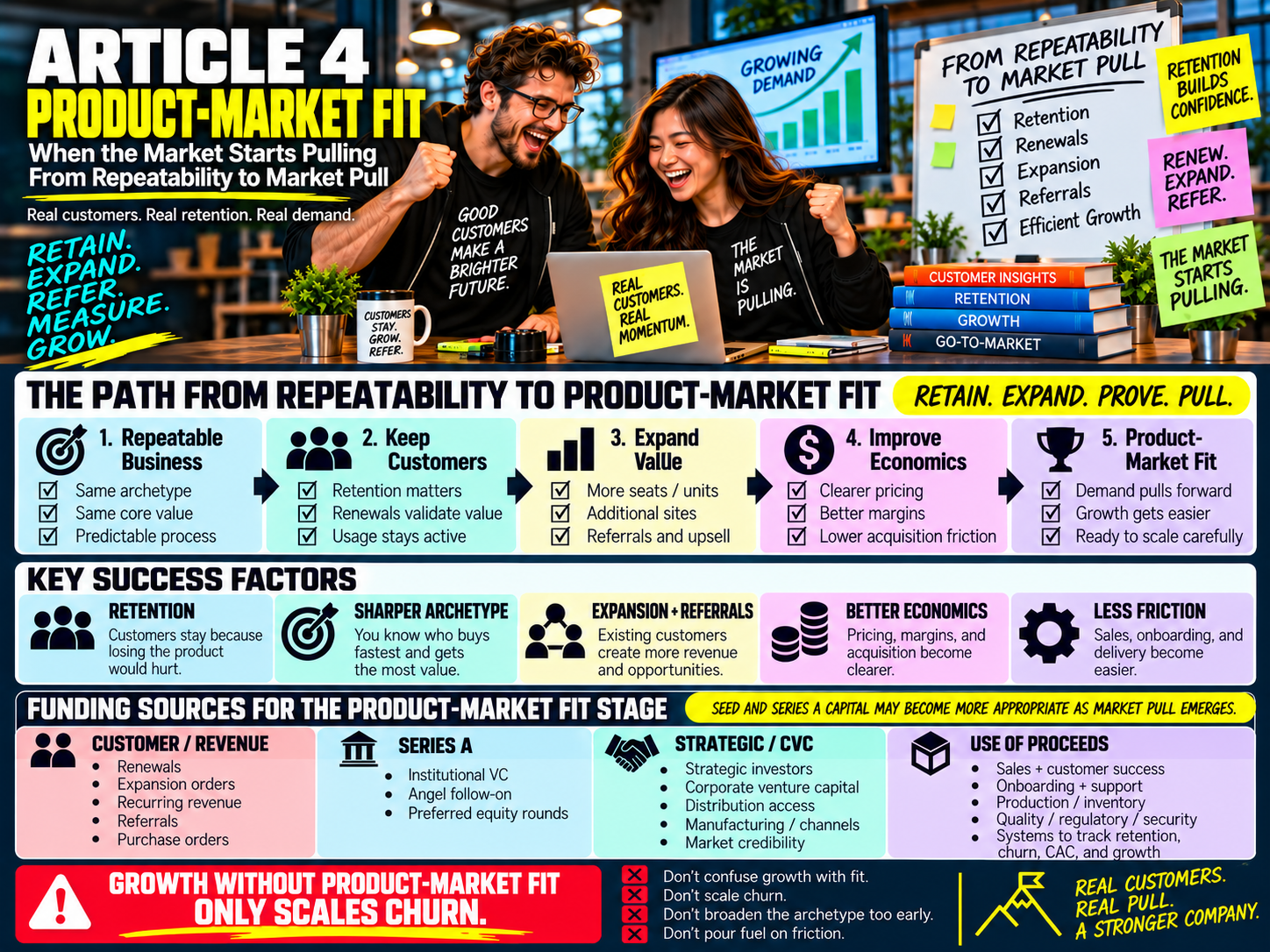
Product-market fit begins to appear when your archetype repeatedly chooses your solution, receives enough value to keep using it, and increasingly pulls you forward through renewals, expansion, referrals, and demand.
The Push Starts Becoming Pull
Before product-market fit, as founders, you will do a lot of pushing. You push for meetings, pilots, adoption, procurement, and renewals. That is normal.
But when product-market fit begins to emerge, the balance starts changing.
- Customers return.
- They renew.
- They expand.
- They introduce you to others.
- Usage grows.
- Testimonials are offered
Sales conversations get easier because the problem, value proposition, and buying story are becoming clearer and aligned. The market begins helping you move. That is pull.
Do Customers Stay?
One of the strongest signs of product-market fit is not acquisition. It is retention and repetition.
A customer who buys once may have been curious. A customer who renews is telling you something different.
Ask:
- Are customers continuing to use the product?
- Are they renewing or expanding?
- Are they buying additional units, seats, locations, or services?
- Are they referring others?
- Would losing your product create a meaningful problem?
If customers disappear after the first contract, you may have proven that you can sell.
You have not necessarily proven product-market fit.
Does the Archetype Still Hold?
Product-market fit does not mean:
“Everyone wants it.”
It usually means a clearly defined group wants it badly.
Your archetype should become sharper, not broader.
You should increasingly understand who buys fastest, receives the most value, renews most consistently, requires the least customization, and refers others.
You should also know whom you should stop pursuing.
Saying no to the wrong customer can be as important as winning the right one.
Measure the Pull
Product-market fit should show up in behavior and economics, not enthusiasm.
Look for patterns:
- Retention improves.
- Renewals become predictable.
- Expansion revenue increases.
- Referrals generate opportunities.
- Sales cycles become more consistent.
- Discounts become less necessary.
- Implementation becomes easier.
- Customer acquisition becomes more efficient.
- Margins improve.
- Usage remains active after onboarding.
The exact metrics depend on the business.
A SaaS company may focus on retention, churn, usage, and expansion.
A hardware or deep-tech company may focus on repeat purchases, deployments, utilization, service revenue, and larger contracts.
The principle does not.
Customers must repeatedly demonstrate that the value is real.
Do Not Confuse Growth With Product-Market Fit
A startup can grow without product-market fit.
You can spend heavily on marketing, hire more salespeople, discount aggressively, customize for every deal, and push more pilots through the pipeline.
Revenue may rise.
But if customers do not stay, renew, expand, or refer others, you may be buying growth rather than earning it.
Product-market fit should make growth increasingly easier, not increasingly painful.
Funding Product-Market Fit
Capital still matters here.
Customer revenue should become an increasingly important source of runway.
Institutional investors may also become more interested because several layers of risk have been reduced.
Capital may support:
- Sales and customer success.
- Production capacity.
- Quality systems.
- Onboarding.
- Regulatory or security requirements.
- Product improvements.
- Hiring people who can replace founder-driven processes.
Series A capital may be more appropriate, alongside strategic investors and corporate venture capital.
Where Does This Capital Come From and What Should It Buy?
As product-market fit begins to emerge, Series A capital can become more appropriate. But founders should understand where that money comes from and what investors expect you to do with it.
A venture capital firm usually does not invest its partners’ personal money. The firm raises a fund from limited partners, or LPs. Those LPs may include family offices, high-net-worth individuals, endowments, pension funds, foundations, corporations, funds of funds, and other institutional investors.
The VC firm then invests the pooled capital in a portfolio of startups, expecting that a relatively small number of successful companies will generate most of the fund’s returns.
That is important.
VC money is not simply money to keep your company alive.
It is capital seeking significant growth and significant returns.
At the Seed stage, investors may include angel investors, angel groups, family offices, micro-VC funds, Seed funds, accelerators, and larger venture firms that invest early.
Seed capital should generally help move the company from early commercial evidence toward stronger repeatability and product-market fit.
The use of proceeds might include:
- Hiring the first sales and customer success employees.
- Turning founder-led selling into a repeatable sales process.
- Hardening the product for broader customer use.
- Reducing implementation and customization.
- Improving onboarding and support.
- Completing security, regulatory, quality, or compliance requirements.
- Expanding production capacity.
- Purchasing inventory or critical materials.
- Improving unit economics.
- Building the systems needed to measure retention, acquisition cost, margins, and customer value.
The objective is not:
“We raised $2 million. Now let’s grow.”
The objective is:
“This $2 million gives us the runway to prove that what we are seeing can become a repeatable, economically attractive business.”
Series A Changes the Question
Series A investors are typically institutional venture funds that invest larger amounts in a priced equity round, commonly involving preferred stock.
At this point, investors generally want more than an interesting product and a few enthusiastic customers.
They want evidence that a repeatable engine is emerging.
The company should increasingly understand its archetype, value proposition, sales process, pricing, customer acquisition, delivery model, retention, and unit economics.
Series A capital can then be used to accelerate what has already been demonstrated.
That might mean:
- Building a larger sales organization.
- Expanding customer success.
- Increasing manufacturing capacity.
- Hiring key management.
- Automating operations.
- Expanding into additional geographic or vertical markets.
- Strengthening supply chains.
- Building infrastructure.
- Increasing inventory.
- Completing regulatory expansion.
- Investing in product development that supports the proven archetype.
There is a major difference between Seed and Series A thinking:
Seed capital often helps prove the machine works. Series A capital increasingly helps build a bigger machine. It supports scaling the successful system that got you here.
If you are still searching for the customer, changing the product for every account, and guessing at the value proposition, adding a large sales team will not solve the problem.
It may simply allow you to burn money faster.
Strategic Investors and Corporate Venture Capital
Strategic investors and corporate venture capital, or CVC, are different.
Their capital usually comes directly from a corporation’s balance sheet or from a dedicated venture fund established by the parent company.
These investors may care about financial returns, but they may also be interested in access to technology, supply chains, new markets, strategic partnerships, future acquisitions, product integration, or competitive advantage.
That can make their capital extremely powerful.
A strategic investor might provide much more than cash:
- Customer introductions.
- Distribution.
- Manufacturing.
- Engineering.
- Testing facilities.
- Supply-chain access.
- Regulatory knowledge.
- Credibility.
- Market access.
But remember the lesson from the Funding Gray Zone:
The instrument’s name matters less than the actual terms.
Strategic capital that gives you $2 million but restricts who you can sell to, license to, partner with, or eventually be acquired by may be far more expensive than it first appears.
Capital Should Have a Job
Whether the money comes from a Seed fund, Series A investor, family office, strategic investor, or corporate venture group, founders should be able to answer:
What exactly will this capital allow us to prove or accomplish that we cannot otherwise accomplish today?
That is the use-of-proceeds question. And your plan should outline that.
If you cannot answer it clearly, you are not ready to raise the round.
The purpose of capital at this stage is not simply to create a longer runway.
It is to use that runway to make the company less risky, more repeatable, more valuable, and increasingly ready to scale.
I think the line worth emphasizing in the article is:
Seed capital helps prove the machine works. Series A capital helps build a bigger machine. Growth capital eventually helps run that machine faster.
What You Need to Prove
By the end of this stage, you should have growing evidence that:
The Customer
- The same archetype keeps buying.
- Customers renew, expand, and refer others.
The Product
- The core product is increasingly stable.
- Customers use it consistently.
- Customization continues to fall.
The Value
- Customers repeatedly receive measurable value.
- The value justifies the price.
- Losing the product would create pain.
The Business
- Sales are becoming more predictable.
- Retention is improving.
- Unit economics are clearer.
- Revenue is increasingly repeatable.
- The market is beginning to pull you forward.
Product-Market Fit Is the Launchpad
The goal of Article 4 is not simply:
Grow revenue.
The milestone is:
Prove that your archetype repeatedly buys, stays, expands, refers others, and receives enough value that demand begins pulling the company forward.
That is product-market fit.
If the market is not pulling yet, keep learning. Do not scale confusion. Do not scale churn. Do not scale excessive customization. And do not scale a sales process that still depends entirely on the founders.
But if the pull is real, the question changes again:
Can we grow rapidly without breaking the business?
That is where we go next.
Article 5: Scale — Pouring Fuel on What Already Works.