





Funding Your Startup: Capital Literacy and Action
In Article 2, we moved from a working prototype to an early customer. The goal was not simply to land a pilot.
It was to prove that your archetype had the hair-on-fire problem you predicted, that your solution worked in their environment, that you delivered measurable value, that they committed resources, and, ideally, that they paid. This is progress.
But one customer does not prove you have a scalable business.
Now comes the next major question:
Can you do it again?
Welcome to Article 3: Repeatability.
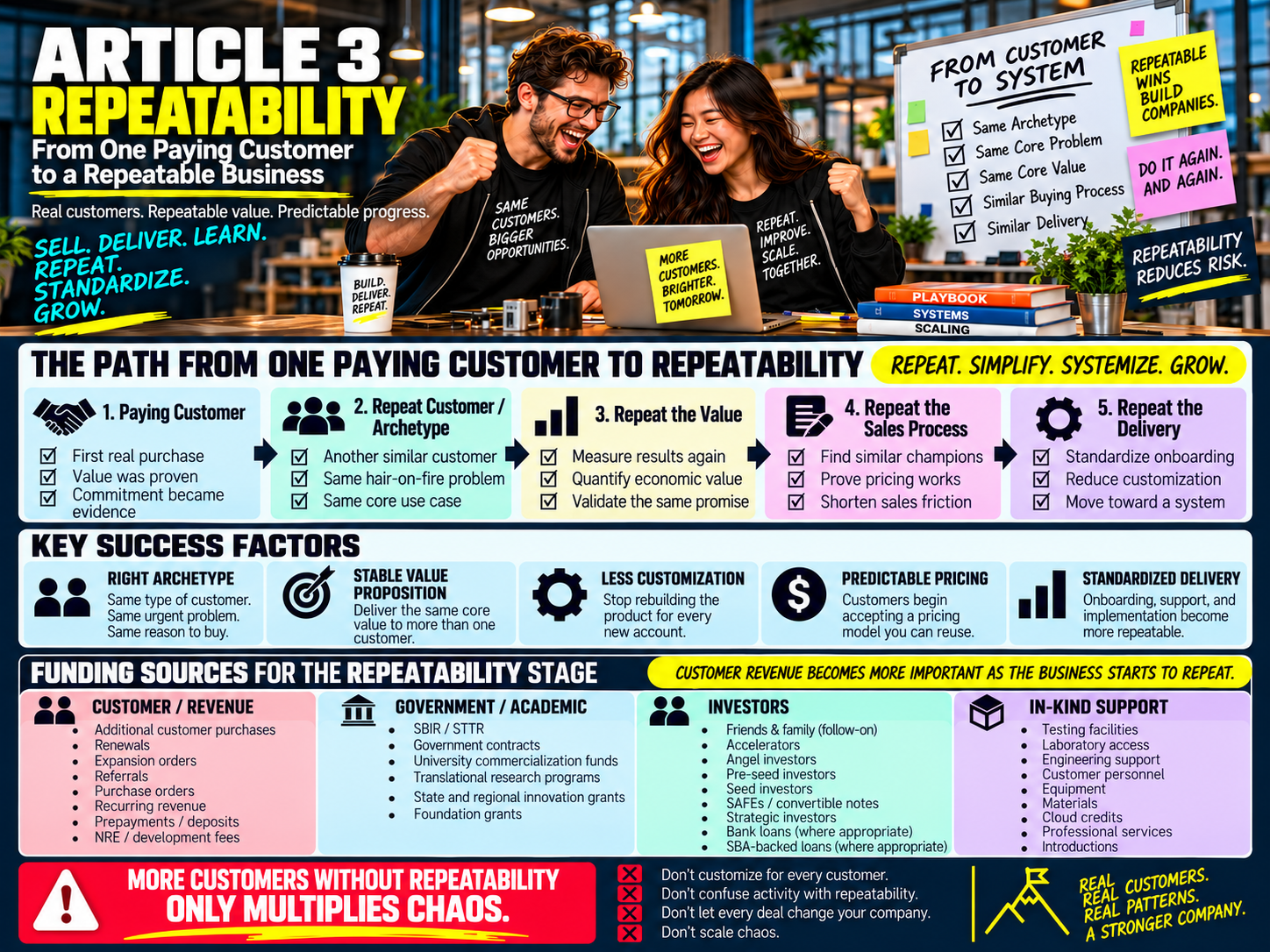
This stage is about proving that another customer with the same archetype can experience the same problem, buy roughly the same solution, receive similar value, and move through a similar sales and delivery process.
If every new customer requires a different product, pricing, implementation, and sales story, you may have revenue.
But you do not yet have repeatability.
Stage 6: Repeatability
Repeatability means your startup is beginning to develop a pattern.
The same archetype.
The same hair-on-fire problem.
The same core value proposition.
The same minimum feature set.
A similar buying process.
A similar pricing structure.
A similar implementation.
And a similar measurable result.
Not identical.
Customers will always differ.
But the differences should not force you to reinvent the company every time.
That is the risk you are trying to remove.
One Customer Can Fool You
Your first customer may be unusually innovative.
They may have a strong internal champion.
They may tolerate product limitations.
They may move faster than the rest of the market.
They may even be willing to help build the product with you.
That is wonderful.
But it can also create false confidence.
The next customer may not behave the same way.
That is why repeatability matters.
You now need to determine whether what happened with Customer 1 was a pattern or an exception.
Ask:
- Does Customer 2 have the same hair-on-fire problem?
- Do they recognize the same value?
- Will they pay a similar price?
- Do they need roughly the same feature set?
- Does the same sales story work?
- Does implementation take roughly the same effort?
- Can you produce similar results?
- Will Customer 3 behave similarly?
You are looking for consistency.
- Stop Customizing Everything
- This is where many startups get trapped.
- Customer 1 wants Feature A.
- Customer 2 wants Feature B.
- Customer 3 wants Feature C.
- Engineering keeps building.
- The sales team keeps promising.
- Everyone is busy.
- But the product is moving in three directions at once.
That is not repeatability. That is custom development.
Ask yourself:
Are we improving the product for our archetype, or building a different product for every customer?
There will always be some customization.
But your core product should increasingly stabilize.
Your archetype should recognize the same core value without requiring you to rebuild the solution from scratch.
If not, you may need to narrow the archetype.
Repeat the Value Proposition
Article 2 forced us to measure value in the real world.
Now you need to determine whether you can produce a similar value again.
Suppose Customer 1 reduced inspection time by 42%.
Great.
What happens with Customer 2?
And Customer 3?
Maybe the result is 38%.
Maybe it is 45%.
That is fine.
You are not looking for identical outcomes.
You are looking for evidence that the same value proposition repeatedly matters to the same archetype.
If one customer saves money, another improves quality, another only cares about safety, and another buys because of regulatory pressure, you may still be learning what your real value proposition is. This is useful information.
But do not confuse learning with repeatability.
Repeat the Sales Process
The product is only part of the equation.
You also need to understand whether you can sell it repeatedly.
Ask:
- Who first engages with you?
- Who becomes the champion?
- Who controls the budget?
- Who approves the purchase?
- How long does the sales cycle take?
- What objections appear repeatedly?
- What proof does the buyer require?
- What procurement steps are common?
- What pricing structure works?
- What causes deals to stall?
- What causes customers to move NOW?
The more predictable these answers become, the stronger your business becomes.
You are beginning to move from:
“We sold one.”
to:
“We understand how to sell this.”
Repeat the Delivery
Now look at what happens after the sale.
- Can you deliver the product repeatedly without exhausting your team?
- How much engineering support is required?
- How long does installation take?
- How much training is needed?
- Can onboarding be standardized?
- Can customer support scale?
- Are margins improving or getting worse?
- Does every deployment require the founders personally?
If every new customer creates chaos, scaling will only create more chaos faster.
Repeatability means the company begins developing processes that others can follow.
Pricing Must Start Becoming Predictable
Early pricing often involves experimentation. Keep in mind, this is normal.
But by this stage, patterns should begin emerging.
- What does the archetype expect to pay?
- How does that compare to the economic value created?
- How do your unit economics look?
Is pricing based on:
- Subscription?
- Units?
- Usage?
- Licensing?
- Hardware plus service?
- Annual contract?
- Savings generated?
- Enterprise agreement?
You are not necessarily searching for perfect pricing yet.
You are searching for a pricing model that customers understand, accept, and can repeatedly purchase.
Funding Repeatability
At this stage, capital should help you prove that the business can be replicated.
You may still use grants, government contracts, strategic partnerships, customer revenue, and non-dilutive programs.
But now, outside investment may become more attractive because the use of capital is changing.
You may need money for:
- Additional sales activity.
- Production.
- Inventory.
- Customer onboarding.
- Implementation.
- Customer success.
- Sales tools.
- Manufacturing.
- Quality systems.
- Regulatory work.
- Hiring people to replace founder-driven processes.
Customer revenue remains especially valuable.
It extends the runway while proving demand.
The objective is not simply to add more money to the bank.
Capital should help you determine whether the sales and delivery system can repeat.
What You Need to Prove
By the end of the Repeatability stage, you should have stronger evidence that:
The Customer
- The same archetype continues to experience the same hair-on-fire problem.
- Multiple customers recognize similar urgency.
- Similar buyers and champions appear across accounts.
The Product
- Customers can use substantially the same core product.
- Customization is decreasing.
- The minimum feature set is becoming more stable.
The Value
- The targeted value proposition can be delivered repeatedly.
- Customers can quantify the benefit.
- The value justifies the price.
The Business
- You can repeatedly acquire customers.
- The sales process is becoming predictable.
- Pricing is becoming consistent.
- Implementation can be standardized.
- Customers are purchasing, renewing, expanding, or referring others.
That is what repeatability begins to look like.
Repeatability Is the Bridge
The goal of Article 3 is not simply:
Get more customers.
The milestone is:
Prove that the same archetype will repeatedly buy substantially the same solution, for the same core reason, receive similar measurable value, and move through a sales and delivery process you increasingly understand. That is dramatically different from landing one great customer.
If you cannot repeat it, keep learning.
- Adjust the archetype.
- Adjust the value proposition.
- Adjust the product.
- Adjust the pricing.
- Adjust the sales process.
But do not pour fuel on something that still changes every time you touch it.
If you can repeat it, however, another major question emerges:
Is the market beginning to pull the product from you?
That brings us to the next major milestone:
Product-Market Fit.
Be on the lookout for Article 4: Product-Market Fit — When the Market Starts Pulling Back.