




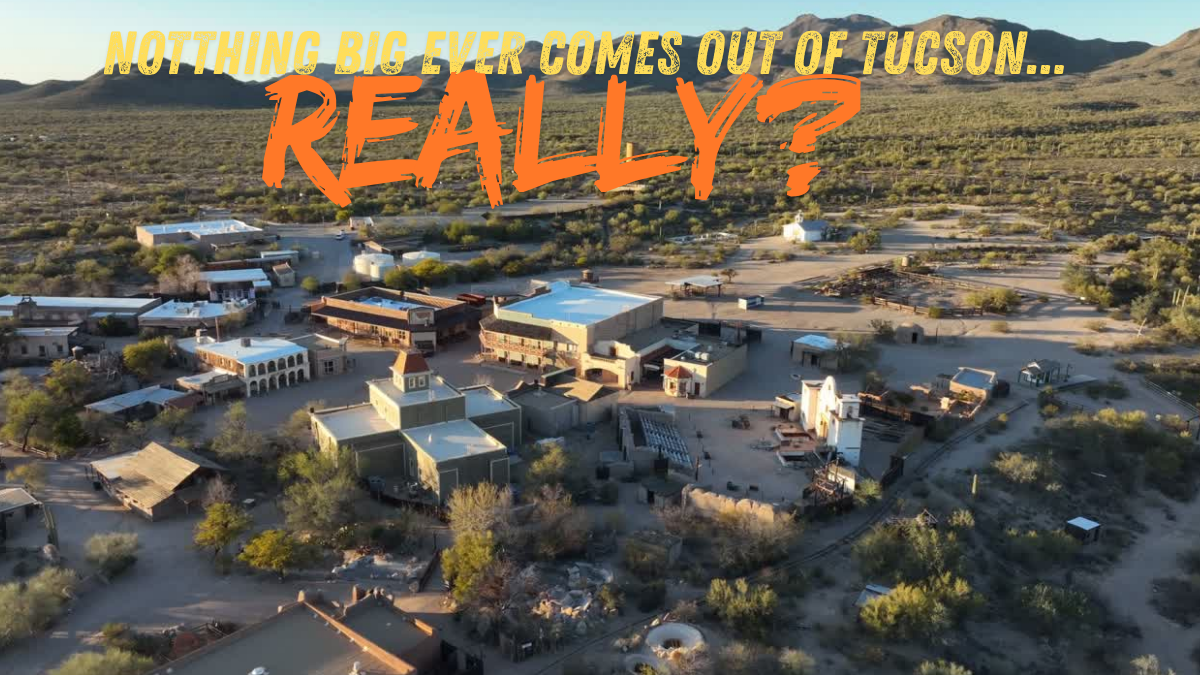

Nothing Big Ever Comes Out of Tucson… REALLY?
The Hidden Titans of Tucson — Introducing the 2025-2026 Generation
And if anyone thinks Tucson’s technology success stories are ancient history, perhaps you haven’t been paying attention.
During the past two years, I noticed another wave of acquisitions, investments, and strategic expansion. Global corporations are discovering what some of us have known for years: Tucson has the engineering talent, intellectual property, and innovation worth investing in. What you see next is just the beginning of where our innovation engine is driving. Our tech is feeding a $ 1 trillion global market, and most of us are not paying attention to it.
Here are some more examples of what’s been happening right under our noses. (Note: The referenced company data was acquired from public sources and may not be all-inclusive or may be somewhat inaccurate.)
- Optical Support, Inc. (Acquired 2026):
A Tucson precision optics and optomechanical engineering company developing sophisticated instruments for commercial satellites and national security applications. Acquired by Rocket Lab in February 2026, Optical Support brought specialized engineering talent, manufacturing capabilities, and advanced optical technologies to Rocket Lab’s growing space systems business. The acquisition price was not disclosed. Remarkably, Rocket Lab found this golden gem right after they acquired GEOST. - GEOST (Founded 2004; Acquired 2025):
A leader in electro-optical and infrared sensor systems used in national security, missile warning, satellite tracking, and space-domain awareness, and acquired by Rocket Lab in August 2025 for $275 million, with up to another $50 million in potential performance-based payments. That’s potentially $325 million for a company built around advanced optical technology and engineering expertise. Apparently, somebody thinks Tucson knows a thing or two about space technology. - BroadPath Healthcare Solutions (Acquired 2025):
A Tucson-headquartered healthcare services company using technology and remote-work capabilities to serve healthcare organizations nationwide. Acquired by Sagility in January 2025, BroadPath demonstrated that scalable, technology-enabled businesses can emerge from Tucson and attract international buyers. The reported acquisition value was approximately $57.9 million. - Phoenix Drill Control (Technology Acquired 2025):
A Tucson-connected innovator applying artificial intelligence and automation to mining equipment. Its Drill Assist technology was purchased by Hexagon in June 2025, helping mining operators improve drilling performance, reduce energy consumption, and increase productivity. The purchase price was not disclosed. Another example of Tucson-developed AI technology finding a global market. - Accelerate Diagnostics (Technology Assets Acquired 2025):
A Tucson-based medical technology innovator developing rapid diagnostic systems to help healthcare professionals identify infections and make treatment decisions faster. Following financial restructuring, selected technologies and intellectual property were acquired by AST Revolution in September 2025. Not every startup story ends with a billion-dollar exit, but valuable innovation can survive financial setbacks and continue making an impact. - AST Revolution (Acquired 2025):
A Tucson-based diagnostic technology business focused on advancing antimicrobial susceptibility testing. Following its acquisition of selected Accelerate Diagnostics assets, AST Revolution was acquired by Bruker in November 2025. The purchase price was not publicly disclosed. Another example of Tucson’s strategic value in biotechnology and medical diagnostics. - LandHub.com (Acquired 2025):
An originally Tucson-based digital marketplace connecting buyers, sellers, and real estate professionals specializing in land transactions. Acquired by an investor group in May 2025, LandHub demonstrates how digital platforms can develop scalable business models far beyond their local markets. Financial terms were not publicly disclosed. - Putt Land Surveying (Acquired 2025):
A traditional surveying business acquired by ZenaTech in October 2025 for approximately $575,000 as part of its expansion into drone-enabled surveying services. While not a conventional deep-tech startup exit, the transaction illustrates how established service businesses can enter emerging technology-driven industries.
But Wait. Tucson Companies Are Also Doing the Acquiring.
Here’s something else that gets overlooked. Tucson isn’t simply producing companies that attract outside buyers. Some of our companies are acquiring businesses, technologies, and intellectual property to expand their capabilities and compete nationally and internationally.
- Phantom Space (Strategic Acquisitions 2026):
A Tucson-based space technology company developing launch vehicles and space transportation capabilities. In February 2026, Phantom Space acquired assets and intellectual property from Vector Launch, followed by the acquisition of Thermal Management Technologies in April 2026. These moves demonstrate how a local aerospace venture can build capabilities through strategic acquisitions rather than developing every technology from scratch. - Pyx Health (Strategic Acquisition 2025):
A Tucson-founded healthcare technology company using digital tools and human support to address loneliness and social isolation. In June 2025, Pyx Health acquired FarmBox Direct, expanding its ability to address food insecurity and other social factors affecting health. The company also announced $47.5 million in investment financing supporting its broader growth strategy. That’s investment capital, not the disclosed purchase price. - Clinisys (Strategic Acquisition 2025):
A Tucson-headquartered diagnostic informatics company providing laboratory information management software to healthcare, environmental, and other scientific organizations. In July 2025, Clinisys acquired Orchard Software, expanding its laboratory technology portfolio and market reach, a Tucson-based technology operation participating in the consolidation of a major national industry.
The Hidden Titans of Tucson Legacy
Tucson’s history is filled with companies (referenced company data was acquired from public sources and may not be all-inclusive or may be somewhat inaccurate) that started small, grew large, and made a global impact long before “ecosystem” and “tech hub” were buzzwords. (From original article)
- 4D Technology (Founded 2002):
Innovators in laser interferometry and optical metrology, 4D was acquired by Nanometrics (Onto Innovation) for $40 million in 2018. Their precision optics power everything from semiconductor inspection to aerospace manufacturing. - SynCardia Systems (Founded 2001):
Creator of the world’s first total artificial heart. Yes, an actual artificial heart, born in Tucson. Backed by $39.4 million in private funding, SynCardia has saved countless lives worldwide. - LaserTel (Founded 2000):
Specialized in high-power laser diodes. Acquired by Leonardo (2009) for $10 million, it became part of a global defense technology network. - Simpleview (Founded 1991):
A digital marketing and data powerhouse serving tourism and destination organizations worldwide. Recently acquired by Granicus (2024), Simpleview is one of Tucson’s most successful software stories. - Ventana Medical Systems (Founded 1985):
The giant you’ve probably never heard of was acquired by Roche in 2008 for $3.4 billion. Ventana transformed cancer diagnostics globally. Its impact on precision medicine echoes from Tucson labs to hospitals across the planet. - Universal Avionics Systems (Founded 1981):
Developed advanced cockpit display and flight management systems that reshaped aviation safety and efficiency. Acquired by Elbit Systems in 2018 for $120 million, this Tucson success continues to power aircraft worldwide. - Canyon Ranch (Founded 1979):
A global leader in health and wellness resorts that turned Tucson into a destination for holistic innovation long before “wellness tech” existed. With $150 million in private investment, it defined a new industry segment. - Mister Car Wash (Founded 1969):
Not exactly “tech,” but definitely scalable. What began as a single Tucson car wash grew into a national powerhouse, raising $240 million in private funding before going public on the NYSE. Proof that scale doesn’t care about your zip code. - Burr-Brown Corporation (Founded 1956):
A pioneering analog semiconductor company that helped power the digital age. Acquired by Texas Instruments in 2000, Burr-Brown became the foundation of TI’s precision analog division, a multi-billion-dollar business today.
This is a small representation of Optics Valley’s product. The product is broader and deeper than most can imagine. I am not most…
No, we aren’t cranking out unicorns, but we have the innovation and the grit to build. That’s a quiet revolution built one engineer, one entrepreneur, and one exit at a time.
So, Nothing Big Comes Out of Tucson?
Let’s get this straight. Rocket Lab acquired two Tucson optics companies in consecutive years. Hexagon purchased AI-driven industrial technology. Bruker acquired a Tucson diagnostics business. Meanwhile, Tucson-based companies are expanding their own capabilities through acquisitions.
And these are only the transactions we can identify from publicly available information. How many more promising companies, breakthrough technologies, and exceptional entrepreneurs are operating quietly across Optics Valley?
Here’s the uncomfortable question: If Tucson can repeatedly create companies valuable enough for global corporations to acquire, why aren’t we creating more of them?
We have demonstrated the ability to innovate. We have the engineering talent, research institutions, specialized manufacturers, and entrepreneurs with the grit to build extraordinary companies.
What we haven’t consistently demonstrated is the ability to turn those individual successes into a LOCAL self-sustaining, scalable startup ecosystem.
Austin didn’t become Austin because of one Dell. Utah didn’t become Silicon Slopes because of one Qualtrics. Their success came from building upon earlier successes, attracting capital, developing talent, and creating opportunities for the next generation of entrepreneurs.
Tucson has its own collection of success stories. The opportunity now is to connect those stories, people, resources, and lessons into something much bigger.
The question isn’t whether Tucson can build globally competitive companies. We’ve already proven that we can.
The question is whether we’re willing to build an ecosystem that makes those successes the expectation rather than the exception.
The Next Chapter: Optics Valley Rising
So, why bother with Tucson?
The next wave of innovation is already forming because we’re standing on the shoulders of giants.
The Tucson metro is the heart of Optics Valley, a globally recognized hub in photonics, optics, defense, and precision manufacturing. The Wyant College of Optical Sciences anchors over $1 billion in annual research, feeding startups in laser systems, optics, sensors, AI vision, autonomous, fusion energy, quantum, biotech, and MedTech technologies.
Add to that the University of Arizona’s Mirror Lab, producing some of the world’s largest telescope mirrors for space exploration and astronomy, and you start to see the pattern. Tucson doesn’t chase trends; it builds them and the tools to make them possible.
Emerging AI, space, defense, and photonics startups are writing the next chapter. The difference? This time, the ecosystem is ready to back them. Networks like Startup Zones, Tucson Tech, Tech Launch Arizona, and Optics Valley are bringing entrepreneurs, mentors, and manufacturers together under one mission: scale what’s next.
Call to Action: Join the Builders
If you’re an entrepreneur, engineer, or visionary who wants to help shape what comes next, don’t wait for permission. Get involved.
Join Startup Zones at startupzones.org, where pre-incubation, mentoring, and training programs help small-town and underserved entrepreneurs scale nationally.
Explore Tucson Tech at tucsontech.org, where innovators, investors, and ecosystem builders come together to create what’s missing.
Because Tucson doesn’t need another plan.
It needs bold moves and builders like you.