





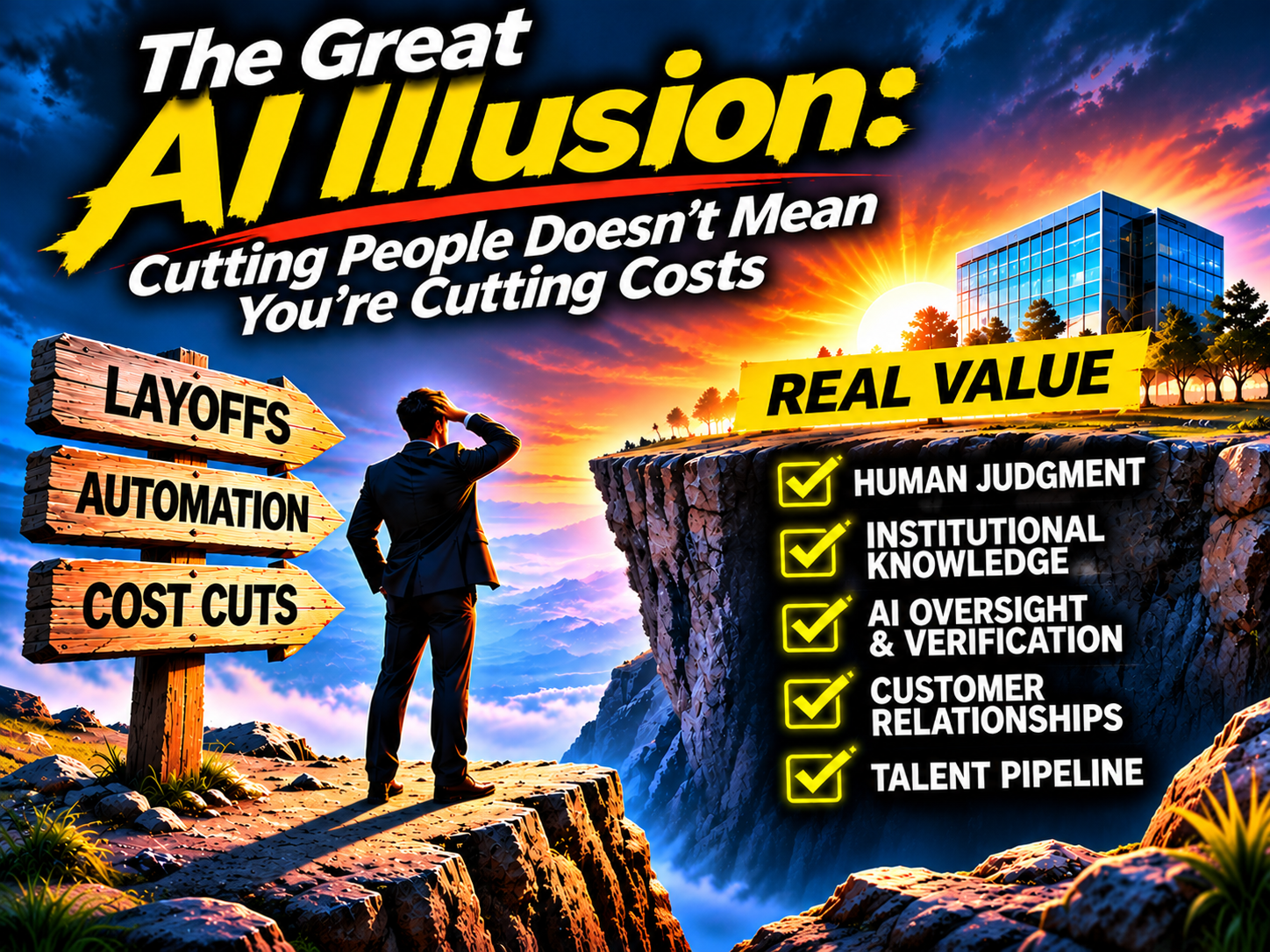

Cutting People Doesn’t Mean You’re Cutting Costs
Executives are celebrating AI productivity gains. But are they measuring the human intelligence required to achieve those gains?
There is a dangerous assumption spreading through corporate boardrooms: If artificial intelligence can perform most of an employee’s tasks, the employee must be expendable.
It sounds logical. It looks impressive in a financial presentation. It might even make shareholders happy next quarter.
But what happens when executives discover they eliminated the very people who made those tasks valuable?
Two studies released in October 2026 should make every CEO, CFO, and board member question the wisdom of cutting employees before understanding what AI can actually replace.
The Company Building AI Is Discovering Something Interesting
On October 16, Anthropic, one of the world’s leading AI developers, released an internal study examining how AI is transforming its own workforce.
The results are fascinating.
By August 2026, AI agents were logging approximately six times as many working hours as their human counterparts. Employee productivity increased substantially, with engineers producing more code and other departments processing more work.
Yet something unexpected happened.
Human attention became a bottleneck.
Anthropic found that interactive AI agents spent approximately 80% of their session time waiting for human input. Meanwhile, the share of employee interactions devoted to managing AI agents increased from 10% in fall 2025 to 22% in spring 2026.
Even more interesting, employees were spending more time coordinating with other humans. Median meeting time increased 20% over the previous year.
Why?
Because generating an answer is not the same as making a decision.
AI can write code, draft contracts, analyze information, and recommend solutions. But someone still needs to understand the business, recognize exceptions, evaluate risks, and accept responsibility for the outcome.
The technology is doing more work. The humans are increasingly responsible for making that work useful.
Source: Anthropic, “How Employment Is Changing at Anthropic,” October 16, 2026.
CEOs Are Starting to Recognize the Difference
One day earlier, KPMG released its 2026 U.S. CEO Outlook, surveying 400 CEOs from companies generating more than $500 million annually.
The findings reveal an interesting contradiction.
While 53% of CEOs plan to reduce workforce in certain areas, 89% expect their overall headcount to increase over the next three years.
Meanwhile, 86% are redesigning roles to support human-AI collaboration, and 83% are prioritizing the retention and retraining of valuable employees.
Perhaps most revealing, only 9% describe AI agents as transformational for their organizations today.
These executives are investing heavily in AI while acknowledging that successful implementation requires people, new skills, and organizational changes.
And 81% believe rising AI costs will reshape corporate margins more than labor costs over the next five years.
Source: KPMG, “2026 U.S. CEO Outlook,” October 15, 2026.
The Institutional Knowledge Nobody Put on the Spreadsheet
Here’s what concerns me.
When executives evaluate an employee, they often focus on measurable activities: reports completed, customer calls handled, software written, or transactions processed.
AI can increasingly perform many of those activities.
But an experienced employee contributes something much harder to measure.
They remember why a customer nearly walked away five years ago. They understand which supplier can be trusted during an emergency. They know why a particular engineering decision was made and what happened when someone previously tried a different approach.
They recognize problems before those problems become expensive.
That knowledge doesn’t necessarily exist in a database. Much of it lives in experience, relationships, mistakes, and judgment.
Eliminate the employee, and you may eliminate the organization’s ability to recognize when AI is wrong.
Worse, Anthropic’s research reveals that junior technical employees declined from 27% to just 9% of technical hires between early 2025 and mid-2026.
That raises another uncomfortable question.
If companies stop developing inexperienced employees today, where will tomorrow’s experienced employees come from?
The Leadership Mistake We Cannot Afford
I’m not arguing against AI. Quite the opposite.
AI offers extraordinary opportunities to improve productivity, eliminate repetitive work, accelerate innovation, and create new value.
But replacing tasks and replacing human capability are two entirely different decisions.
Before eliminating positions, executives should measure the full cost of automation, including human supervision, error correction, retraining, loss of institutional knowledge, loss of customer relationships, and the possibility of rehiring expertise they prematurely discarded.
Test the assumptions. Measure the outcomes. Preserve the capabilities that matter.
A company that uses AI to make experienced employees more productive may create far greater value than one that eliminates them.
The lesson is simple:
AI can accelerate the work.
But it takes human intelligence, experience, and judgment to ensure the work actually matters.
The winners won’t necessarily be the companies with the fewest employees. They’ll be the companies that understand how to create the greatest value by combining artificial and human intelligence.
And executives who confuse those two may discover that the most expensive AI mistake wasn’t the technology they purchased.
It was the institutional knowledge they willingly threw away.
Key research references:
- Anthropic (October 16, 2026), How Employment Is Changing at Anthropic. https://www.anthropic.com/research/employment-at-anthropic
KPMG (October 15, 2026), 2026 U.S. CEO Outlook. https://kpmg.com/us/en/media/news/kpmg-us-ceo-outlook-2026.html