



Funding Your Startup: Capital Literacy and Action
In Article 4, we focused on Product-Market Fit. The objective was not simply to grow revenue. It was to prove that your archetype repeatedly buys, stays, expands, refers others, and receives enough measurable value for the market to begin pulling your company forward.
If that pull is real, another question emerges:
Can you grow rapidly without breaking the business?
Welcome to Article 5: Scale.
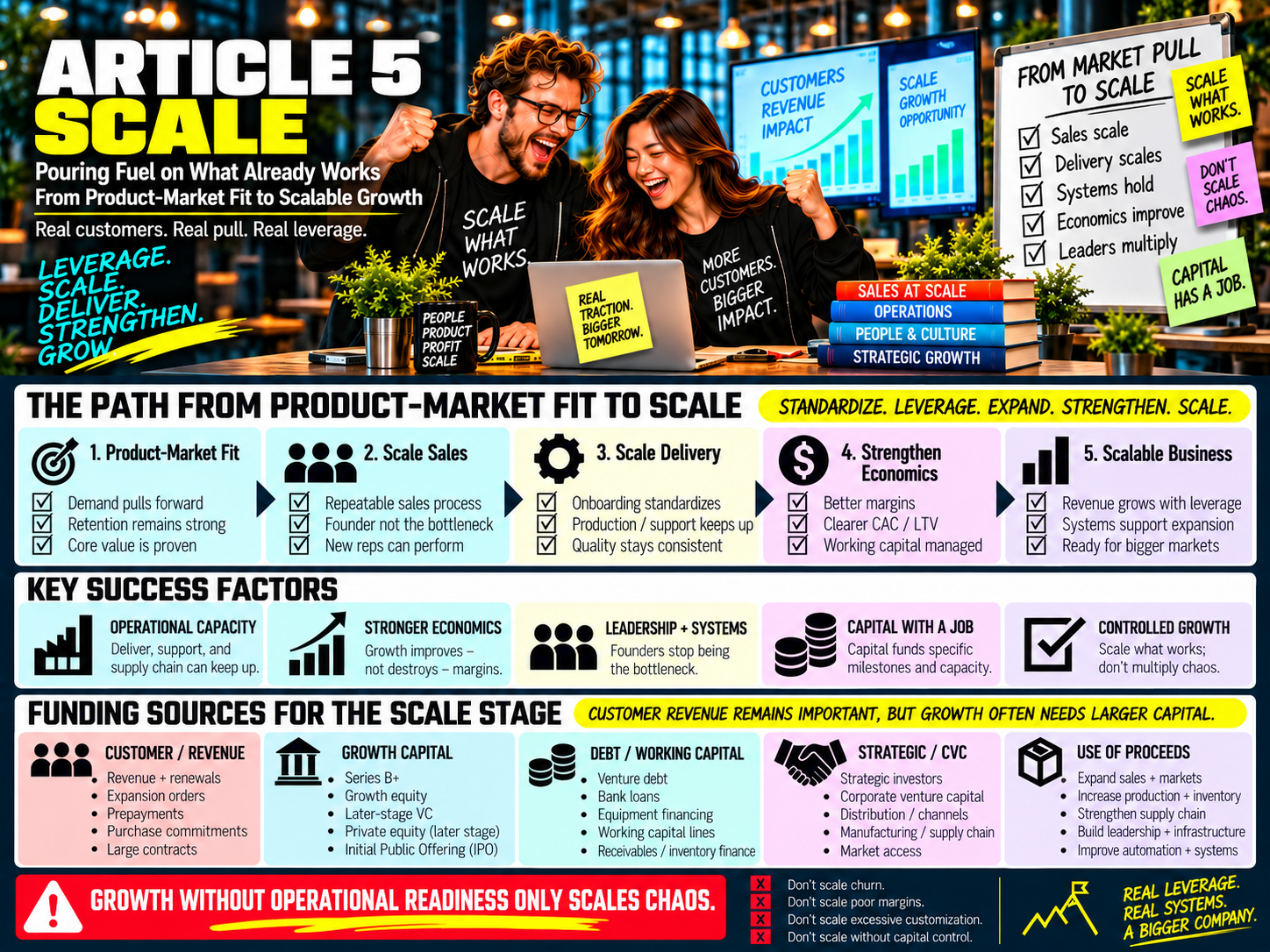
Scaling is not simply doing more. It is increasing customers, revenue, production, and market reach without increasing cost, complexity, and chaos at the same rate. That distinction is critical.
Growth Is Not the Same as Scale
You can grow by hiring more people, adding salespeople, spending more on marketing, carrying more inventory, and accepting every customer willing to buy. Revenue may increase dramatically.
But if every additional dollar of revenue requires another dollar, or more, of expense, you are growing. You are not necessarily scaling.
A scalable business creates leverage. The product, systems, people, technology, manufacturing, distribution, and processes that got you here should allow substantially more business to flow through the company without requiring you to rebuild it every time.
More customers without leverage can simply create more chaos.
Scale What You Already Know Works
This is not the stage to rediscover your archetype or completely reinvent the value proposition. You should already have strong evidence on the hair-on-fire problem, product, pricing, customer acquisition, retention, delivery, economics, and the reasons customers continue to buy.
Now the job changes.
You are taking something that works and building a larger system around it.
That means the questions become operational:
- Can someone other than the founder sell the product?
- Can new salespeople learn a repeatable sales process?
- Are buying objections predictable?
- Can pricing be consistently explained?
- Can customers be qualified without the founder sitting in every conversation?
Founder-led sales may have gotten you here, but eventually, the founder can become the bottleneck.
The objective is not to hire more salespeople. It is to give them a system that works.
Can You Deliver What You Sell?
More sales create another challenge: you have to deliver.
- Can implementation keep up with demand?
- Can onboarding be standardized?
- Can manufacturing increase without destroying quality?
- Can suppliers support additional volume?
- Can customer support handle more accounts?
- Can your software, infrastructure, cybersecurity, and internal systems handle dramatically more activity?
And for physical-product companies, another issue quickly appears: working capital.
You may have to purchase components, manufacture inventory, hire people, and carry receivables months before the customer actually pays you.
Growth can consume cash faster than many founders expect.
A company can be profitable on paper and still run out of cash.
That is why scaling requires more than demand. It requires operational and financial capacity to satisfy that demand.
Protect the Economics
Scaling bad economics does not fix the economics. Are your unit economics working? If not, that needs to be fixed first.
By now, you should have a better understanding of gross margins, customer acquisition cost, customer lifetime value, retention, churn, sales cycle length, production costs, support costs, and working capital requirements.
The exact metrics will depend on your business model. But the principle remains the same:
As the company grows, the economics should become clearer and increasingly sustainable.
More customers should not automatically mean greater losses, more customization, and increasingly exhausted employees.
If that is happening, stop and understand why before pouring more capital into growth.
Funding Scale
This is where funding can grow significantly.
Customer revenue should remain important. In a healthy company, customers increasingly help finance growth. But rapid expansion may require far more capital than operating cash flow can provide.
Depending on the business, capital may come from later-stage venture firms, growth equity investors, strategic investors, corporate venture groups, banks, venture-debt providers, equipment lenders, working-capital facilities, government contracts, strategic contracts, customer prepayments, and purchase commitments.
At this stage, founders need to become much more sophisticated about matching the type of capital to the job it needs to perform.
Equity may make sense when the market opportunity is large and speed matters. Debt may become attractive when revenues and cash flows are predictable enough to support repayment without surrendering additional ownership.
Equipment financing can finance machines.
Working-capital facilities can finance inventory and receivables.
Strategic capital may provide access to manufacturing, distribution, and supply chain, customer introductions, or entry into new markets.
The same lesson applies throughout this entire series:
The instrument’s name matters less than the actual terms and what the capital allows you to accomplish.
Where Does Growth Capital Come From?
Later-stage venture firms raise capital from limited partners much like earlier-stage venture firms. Those LPs may include pension funds, endowments, family offices, foundations, sovereign wealth funds, insurance companies, corporations, and other institutional investors.
These funds are looking for companies capable of generating substantial returns. By this stage, they are not simply investing in a promising idea. They expect evidence that a scalable economic engine already exists.
Growth-equity investors may invest even larger amounts in companies with significant revenue and clearer economics. Strategic corporations may invest directly from their balance sheets or corporate venture funds. Banks and other lenders look at the opportunity differently: they care considerably more about your ability to repay.
As your company matures, predictable revenue, receivables, inventory, equipment, assets, and cash flow can create financing options that were simply unavailable when you had nothing more than an idea and a pitch deck.
What Should the Capital Buy?
This is where the use-of-proceeds question becomes critical.
Growth capital may finance expanded sales, additional manufacturing capacity, inventory, new geographic markets, stronger supply chains, distribution, automation, experienced leadership, infrastructure, customer success, regulatory expansion, cybersecurity, or acquisitions.
But saying:
“We need $20 million for 24 months of runway”
It is not enough.
A stronger answer is:
“This capital allows us to triple production capacity, expand into two additional markets, build the sales organization, strengthen our supply chain, and create the operating infrastructure required to support the next level of growth.”
Now the capital has a job.
And the founders can be held accountable for what that capital is supposed to accomplish.
Don’t Pour Fuel on a Fire You Cannot Control
Capital is an accelerant.
If the business works, capital can accelerate opportunity.
If the business is broken, capital can accelerate the problems.
Do not scale churn, poor margins, excessive customization, weak leadership, broken processes, or a supply chain that cannot deliver. And do not scale simply because an investor offered you money.
Scale because the evidence says the company is ready.
What You Need to Prove
At this stage, you should increasingly be able to demonstrate that demand extends beyond a handful of early customers, the market opportunity supports meaningful growth, revenue is becoming predictable, retention remains strong, and the economics support expansion.
Your organization also needs to change. The founders cannot be the answer to every problem. Leadership responsibilities must spread throughout the company, processes must become repeatable, and systems must support substantially more customers and employees without the culture and customer experience falling apart.
And your capital strategy should be equally clear. You should know how much money you need, what it will fund, what milestones it should produce, and what you are giving up to obtain it.
The Startup Capital Roadmap
We began this series with an idea.
Then, step by step, we removed risk.
Article 1: Is there a hair-on-fire problem, the right archetype, technical viability, and a working MVP?
Article 2: Will a real customer use it and pay?
Article 3: Can you do it repeatedly?
Article 4: Is the market beginning to pull?
Article 5: Can you scale what works without breaking the business?
That is what capital literacy is really about.
The objective was never simply to raise money.
It is to use the right capital, at the right time, to eliminate risk, achieve the next milestone, extend runway, increase value, and earn the right to move forward.
Idea. Derisk. Develop. Derisk. Validate. Derisk. Prove. Derisk. Fund. Reach Product-Market Fit. Scale.
And only when the evidence says it is time:
Pour fuel on what works.