






From Small-City Cliques to Institutional Tribalism
At first glance, Tucson’s startup ecosystem and the global response to COVID-19 seem to have little in common.
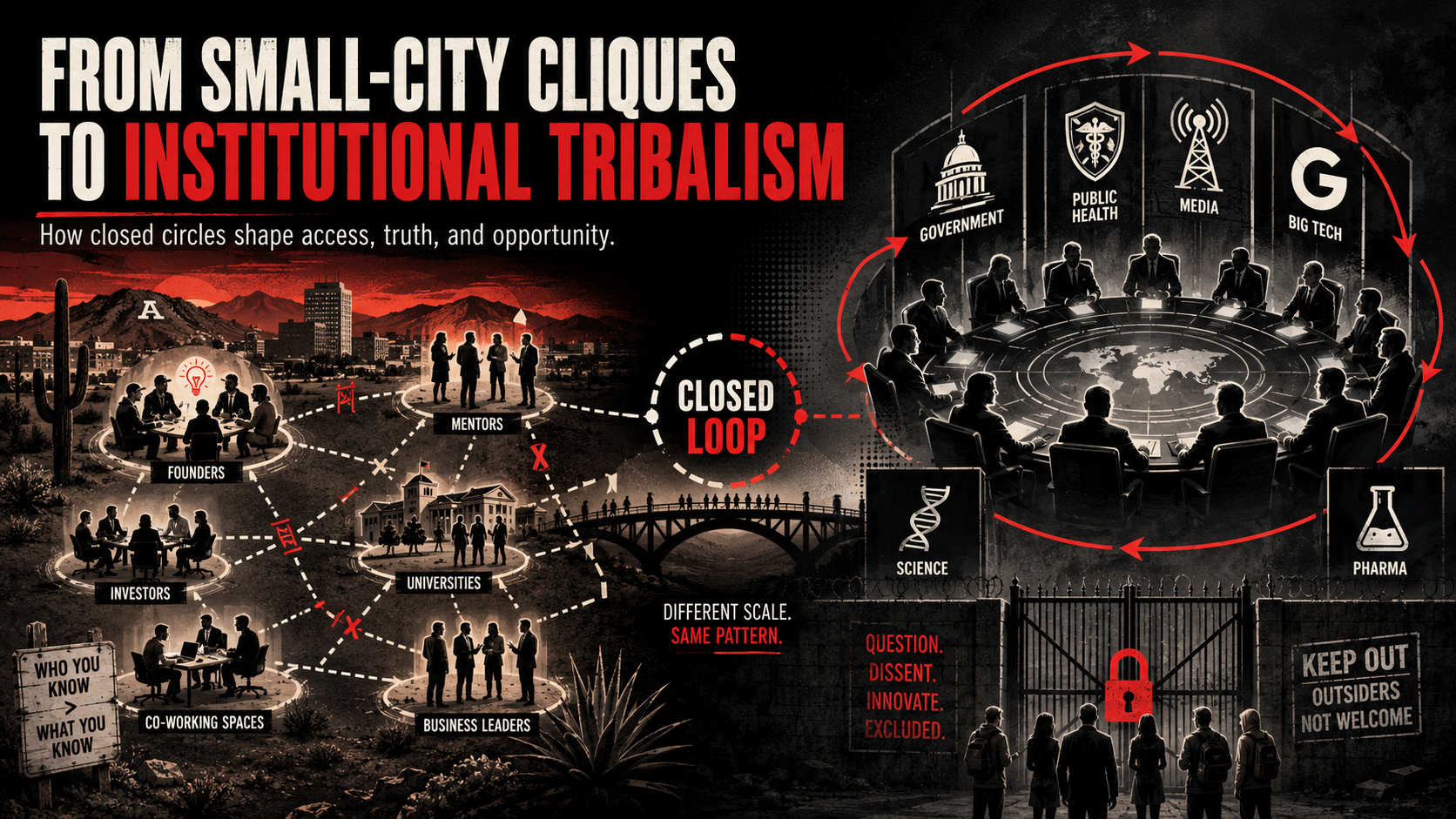
One involves founders, universities, investors, mentors, and community groups in a mid-sized city. The other involved governments, public-health agencies, scientists, media companies, technology platforms, pharmaceutical companies, and billions of people.
The scale is very different.
But the group behavior is surprisingly similar.
Both systems show what happens when trust becomes concentrated inside familiar circles, access depends on relationships, and new ideas are judged by who presents them rather than by their actual value.
In Tucson, we often call this the closed-loop effect.
During the pandemic, it became institutional tribalism.
The Closed Loop Starts With Familiar People
In Tucson’s startup ecosystem, people often work with those they already know. Trust is built through shared history, personal relationships, university ties, past employers, and familiar organizations.
That is understandable. Familiarity lowers risk.
The problem begins when familiarity becomes the main requirement for participation.
A founder can attend events, meet leaders, share ideas, and offer to help. Yet those conversations may never turn into real opportunities. Introductions are promised but do not happen. Support sounds positive, but action moves slowly.
No one has to exclude newcomers officially.
The structure does it automatically.
The pandemic response developed a similar pattern. Government agencies, senior scientists, universities, journalists, technology companies, and health organizations depended heavily on one another for information and credibility.
Government officials became trusted media sources. Media coverage strengthened the authority of those officials. Technology companies used government guidance and media fact-checks to decide what information could remain online.
Each part of the system supported the others.
Just as a founder may struggle to enter Tucson’s trusted circles, a scientist or doctor who challenged the main pandemic narrative could struggle to enter the public conversation.
The question was not always, “Is the evidence strong?”
Too often, it became, “Is this person one of us?”
Trust Was Personal Instead of Portable
In an open startup ecosystem, trust is portable.
A founder who builds a product, wins customers, creates jobs, or proves expertise can carry that credibility into new relationships. The work speaks for itself.
In a more closed ecosystem, trust depends on who introduces you, where you worked, or which circle accepts you.
The pandemic revealed a similar problem.
Scientific evidence should be portable. A strong argument should matter whether it comes from a famous government official, a respected university, an independent doctor, or an unfamiliar researcher.
Instead, credibility often became connected to institutional identity.
An idea supported by a major agency was quickly accepted. A competing idea could be dismissed because it came from a person outside the approved group.
The same evidence might be treated differently depending on who presented it.
That is a clear sign of tribal thinking.
Insiders Kept Working With Insiders
The closed-loop pattern is predictable:
Trusted relationships become stronger.
Access moves through referrals.
Newcomers struggle to enter.
Insiders keep choosing insiders.
New ideas face resistance.
The pandemic followed a similar path.
A small group of institutions became the main authorities. Their views became the accepted narrative. Media organizations repeated those views. Technology companies enforced them. Competing opinions were treated as threats.
No large conspiracy was required.
People inside these systems may have honestly believed they were protecting safety, quality, or public trust. But good intentions do not prevent a system from becoming closed.
A clique can form without anyone saying, “Let’s create a clique.”
Institutional tribalism can grow without anyone saying, “Let’s silence opposing views.”
It forms through repeated choices about whom to invite, trust, fund, quote, promote, and ignore.
Eventually, insiders stop noticing the walls around them.
Events and Press Conferences Do Not Equal Openness
Tucson has many networking events, panels, pitch competitions, and meetups. But attending an event does not mean someone has been welcomed into the deeper network.
Visibility is not the same as integration.
A person may meet dozens of people and still receive no real introductions, partnerships, customer opportunities, or support.
The pandemic had its own version of surface-level openness.
Press conferences were held. Scientific papers were published. Officials answered questions. Experts appeared on television.
Yet the boundaries of acceptable discussion were often narrow.
Some theories and policy alternatives were dismissed before they received a fair hearing.
That is like inviting a founder to a networking event while keeping them out of the room where real decisions are made.
A system can look open while still controlling who has influence.
Connectors Can Become Gatekeepers
Tucson depends on a small number of people who open doors, make introductions, and connect founders with institutions.
Good connectors are essential.
But when too few people control access, connectors can become gatekeepers.
The pandemic response showed the same risk. A limited number of officials, scientists, editors, fact-checkers, and technology leaders had great influence over which experts were heard and which ideas were labeled misleading.
Every organization must make choices. Gatekeeping is not always dishonest.
The danger begins when the same close group defines credibility, controls access, judges opposing views, and protects its own decisions.
At that point, the system is reviewing itself.
Closed Systems Protect Their Identity
Closed systems do not reject every new idea. They usually resist ideas that threaten existing authority, relationships, programs, or reputations.
A Tucson founder may receive polite praise but little support if the idea challenges established organizations.
During the pandemic, certain questions threatened more than a policy. They threatened the reputation of the institutions that defended it.
Were school closures continued too long?
Were distancing rules supported by strong evidence?
Was natural immunity given enough attention?
Was the laboratory-origin theory dismissed too quickly?
These questions challenged major decisions and the people who made them.
Once institutions connect their identity to a position, changing that position becomes difficult. Protecting the organization can slowly become more important than finding the truth.
Closed Systems Waste Human Potential
The damage caused by Tucson’s cliques includes slower startup growth, missed investments, weak collaboration, brain drain, and founders leaving the region.
The pandemic’s consequences were far greater. They included learning loss, lost businesses, damaged careers, delayed medical care, isolation, and declining public trust.
The scale was different, but the basic failure was the same.
Closed systems waste knowledge and talent.
In Tucson, a capable founder may leave because no one opened the right door.
During the pandemic, a scientist or doctor may have stayed silent because asking questions could damage a career.
In both cases, the system loses ideas it may urgently need.
The Answer Is to Open the System
Tucson is not hopelessly broken. It is under-designed.
It needs more connectors, clearer paths to opportunity, stronger links between institutions, and faster ways for newcomers to earn trust.
Emergency response systems need similar changes. They need independent critics, public explanations of uncertainty, transparent records, competing models, protection for scientific disagreement, and time limits on emergency powers.
The answer is not to destroy institutions.
It is to prevent them from becoming closed tribes.
Final Thought
Small-city cliques and global institutional tribes are not identical.
But they grow from the same human habits:
comfort with familiar people;
fear of outsiders;
protection of status;
control of access;
and resistance to uncomfortable ideas.
In Tucson, these habits can slow innovation and push entrepreneurs away.
During the pandemic, they shaped policies, information, careers, and lives.
The danger begins when a tribe controls the doors, defines the truth, and punishes people for asking whether the system could do better.
Whether we are building a startup community or responding to a global emergency, the lesson is the same:
Closed circles protect themselves. Open networks discover what closed circles miss.
We all want the ecosystem to thrive, so let’s change the current dynamic one person at a time.