





The Most Expensive AI Mistake?
Draining Your Institutional Knowledge on a Whim.
Executives are under enormous pressure to use artificial intelligence. Investors want higher productivity. Boards want lower costs. Competitors are announcing AI strategies. Leaders fear being left behind.
That pressure can lead to a dangerous question:
“How many employees can we replace with AI?”
It may sound efficient. It may look great on a spreadsheet. It may even improve next quarter’s financial results.
But cutting jobs blindly can become one of the most expensive mistakes a company makes.
AI can write reports, create software, summarize documents, analyze data, and automate repetitive tasks. It can help one employee accomplish work that once required several people. Those gains are real.
But a job description does not capture everything an experienced employee knows.
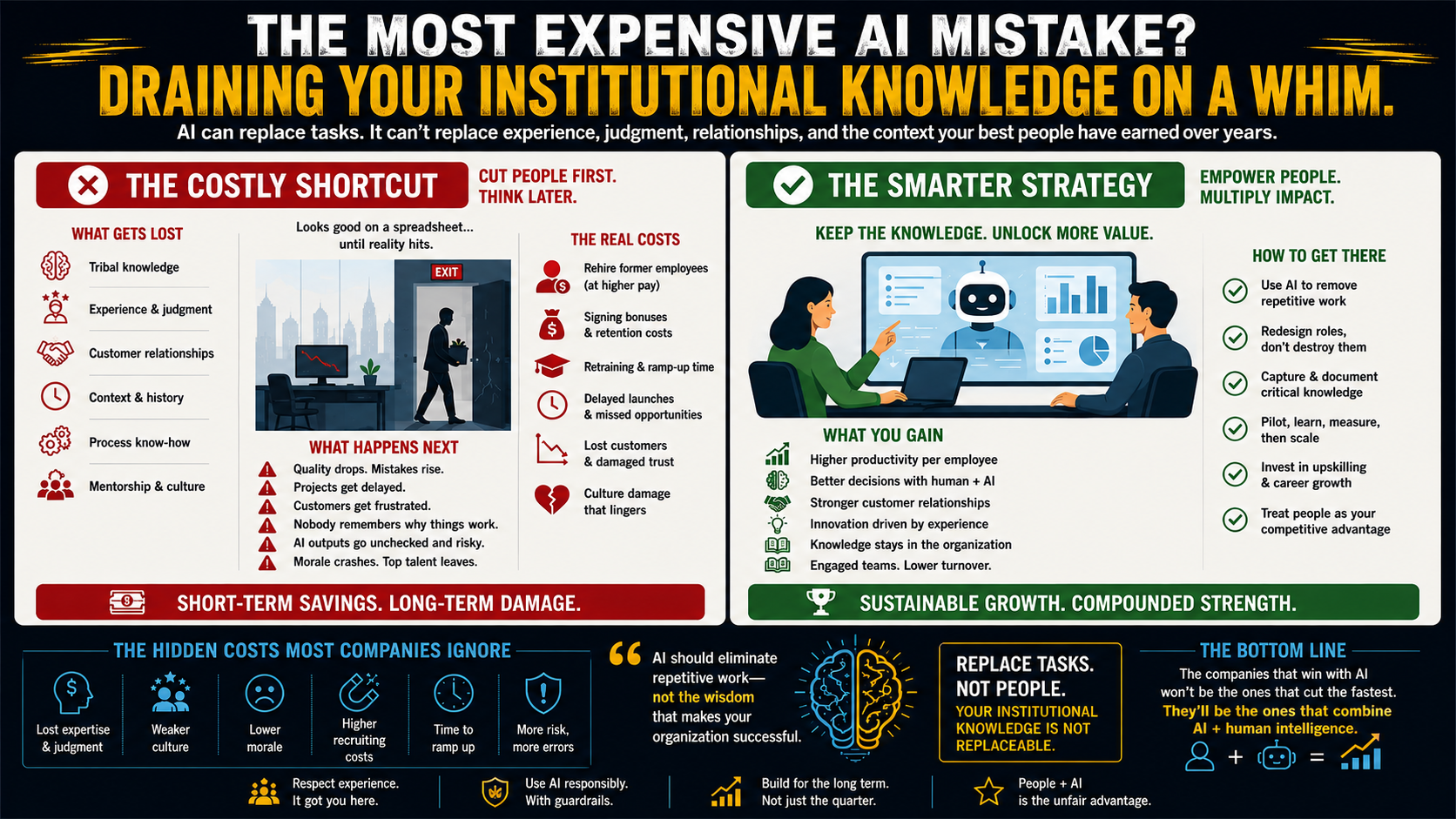
Long-term employees carry institutional knowledge. They know why a process was created, not just how it works. They remember the customer complaint that led to a product change. They know which supplier can be trusted during an emergency. They understand the hidden weaknesses in an old system. They know which shortcuts are safe and which ones could cause a disaster.
Much of this knowledge is not written down.
It lives in conversations, decisions, relationships, mistakes, and years of experience.
When companies eliminate people simply because an AI system can perform some of their tasks, they may unknowingly drain the organization of this knowledge. The damage may not appear immediately. At first, costs go down, and productivity may seem to rise.
Then the problems begin.
Customers are no longer receiving the same level of care. Small quality issues become larger ones. Projects are delayed because no one remembers why earlier decisions were made. New employees struggle because the mentors who once trained them are gone. AI produces answers, but nobody has enough experience to recognize when those answers are incomplete, misleading, or dangerously wrong.
The remaining employees are forced to carry more responsibility. Morale drops. Trust disappears. Workers begin wondering whether they will be next. Some of the strongest people leave voluntarily before they can be pushed out.
Soon, the company discovers that it did not eliminate unnecessary labor. It eliminated judgment, relationships, context, and trust.
Then comes the costly part: rehiring people.
The former employees may no longer be available. Some may have joined competitors. Others may be willing to return only for higher salaries, signing bonuses, better benefits, or stronger job protections. New employees must be recruited, trained, and given time to understand the business.
Meanwhile, product launches may be delayed, customers may leave, equipment may fail, and costly mistakes may multiply.
The original savings can disappear quickly.
Companies have made similar mistakes before. They outsourced technical teams and later brought the work back after quality declined. They reduced customer-service staff and rebuilt the teams when customers became frustrated. They cut maintenance positions and paid far more when neglected equipment failed. They eliminated experienced manufacturing workers and later discovered that new employees could not quickly replace decades of hands-on knowledge.
AI makes the temptation stronger because its capabilities are impressive. But impressive is not the same as dependable in every situation.
AI can recognize patterns, but it may not understand why an exception matters. It can recommend a decision without personally carrying the consequences. It can process thousands of documents without knowing which unwritten agreement keeps an important customer from leaving.
The smarter question is not, “How many jobs can AI eliminate?”
It is, “How can AI make our people more capable, productive, and valuable?”
That change in thinking matters.
A company might use AI to remove repetitive tasks while keeping experienced employees focused on customers, innovation, quality, mentoring, and difficult decisions. It might redesign roles rather than destroy them. It might capture employee knowledge before anyone leaves. It might test AI in limited areas, measure the results, and expand carefully rather than make dramatic cuts based on assumptions.
Leaders should also calculate the full cost of job elimination. Salary savings are easy to measure. Lost knowledge, weakened culture, lower morale, customer frustration, recruiting expenses, retraining time, operational failures, and damaged trust are harder to place in a spreadsheet.
That does not make them less real.
Artificial intelligence should help organizations become smarter. It should not push leaders into making reckless decisions faster.
Cutting jobs on a whim is not an AI strategy. It is a short-term financial reaction masquerading as innovation.
The companies that win will not be the ones that fire people the fastest. They will be the ones who understand which tasks should be automated, which skills must be protected, and which employees can create even greater value with AI by their side.
AI may replace tasks.
But draining a company of years of knowledge, experience, and trust can create a hole that no machine can quickly fill.
Replacing people may look easy.
Replacing what they know can cost a fortune.
Lesson Learned:
AI adoption should never be confused with indiscriminate workforce reduction. Companies must recognize that employees possess critical institutional knowledge that machines cannot easily replicate. Before eliminating roles, leaders should carefully evaluate what tacit expertise, relationships, and judgment may be lost. Sustainable AI strategies focus on augmenting human capability rather than replacing it outright. Organizations that preserve and amplify human knowledge alongside AI will outperform those that treat people as expendable cost centers.
Example:
A well-known example comes from Zynga, the gaming company behind hits like FarmVille. In 2012, Zynga laid off around 5% of its workforce as part of a cost-cutting effort during a downturn. However, as the company struggled to maintain product quality and keep games competitive, it later had to rehire and rebuild parts of its talent base, especially in key engineering and product roles. The rapid turnover highlighted how difficult it is to replace experienced teams in fast-moving, knowledge-heavy environments like game development, where institutional know-how directly impacts product success and user retention.